
PART IVB2C: THE PHEIDIAN PLANORBIDAE
[ EXCERPT ]
A4.2. WHIRLING RECTANGLES, SQUARES, AND EQUIANGULAR SPIRALS
In some respects the subject of "Whirling" rectangles represents a modern two-part puzzle--not so much the topic per se
as the apparent stagnation and lack of understanding that (for whatever reason)
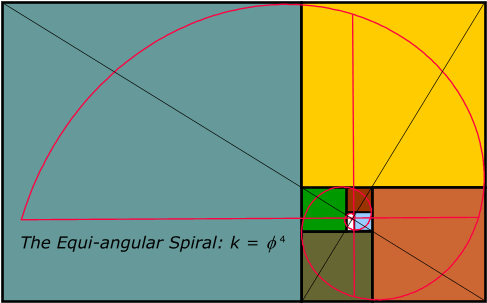
currently attends it. This rectangle--"Golden" in the sense that the ratio
between the length and the width is 1.61803398874 : 1 (i.e., Phi : 1 )--is more often than not shown in association with the side view of Nautilus pompilus,
which is the first part of the puzzle, since the spiral assignment
for Nautilus has long been known and the spiral in question has a growth factor more than twice
that of the latter. The second part of the puzzle concerns why the matter
is rarely taken further; it is surely a natural step when a spiral is shown
in relation to a rectangle with attendant squares, etc., to investigate the
details and if possible determine what lies behind the observed effect. By
way of explanation, maintaining the same
ratio between rectangle and square throughout, the original rectangle may
be successively partitioned into firstly a square with both sides equal to
the previous width, and secondly, into another similar golden rectangle,
and so on, rotating 90 degrees with each successive partition. As it so happens,
the combination of the quarter-perimeters inscribed in the resulting squares
turn out to closely approximate an equiangular spiral, as is often demonstrated
in discussions concerning this topic, though the spiral itself (actually
k = Phi 4 ) is rarely identified. Nor is the representation a true spiral, as most commentators point out, though few tend to
elaborate much further. An exception is Jay Hambidge,36 who also describes a similar (though
not identical) treatment of "Whirling Rectangles" with respect to root-5
rectangles in
Dynamic Symmetry, (1920).
As for the "Golden Rectangle" and the observed spiralling effect, it is perhaps useful to remain with the
astronomical side of the matter for a while and consider again what was stated
in Section IV (Spira Solaris Archytas-Mirabilis), i.e.,
With respect to the present astronomical application and the exponential planetary framework it may be noted that all mean periods (planet-synodic-planet) increase by phi itself while all planetary periods per se increase by phi squared. Therefore the required period function should increase by the square root of phi per 90-degree segment and by phi squared per revolution. Thus for explanatory purposes, commencing with unity, the first 90-degree segment would have the value 1.27201965, the second (the half-cycle, or 180 degrees) 1.618033989 (phi itself), the third 2.058171027, and at the full cycle, phi squared = 2.618033989.
Not that this is new, though the above application is somewhat specialized. In fact Jay Kappraff 37shows
quadrantal growth for the equiangular spiral in this exact manner in a schematic
diagram of the logarithmic spiral, replete with attendant rotating and expanding
rectangles (Figure 2.11,1991:46). Here it may be noted that in general terms
the fixed increase per quadrant is the fourth root of the growth factor per revolution, as
Sir D'Arcy Wentworth Thompson was obviously aware in citing the square root
for the half-cycle and the square root again for the quarter.38 The fourth root
in this context applies to all pheidian spirals and as such it is also
inherent in the "Golden Rectangle," though this may not be immediately apparent
for a number of reasons. Firstly, the associated spiral is in a sense incomplete
with respect to the full rectangle and largest square, whereas it is always
"complete" with respect to the smaller rectangles, etc.(see Figure 14 above).
Secondly, quadrantal growth in this application is more naturally understood
with respect to what may be termed the "outer" spiral as opposed to that enclosed
by the rectangle itself. Thirdly, though identical in form, in addition to
being external the outer spirals are also inclined at specific angles to
both the rectangle and the inner spiral. This should become more apparent
from Figure 15, which incorporates the above data for Spiral Solaris and also
shows the orientation of the double spirals and the parent rectangle:
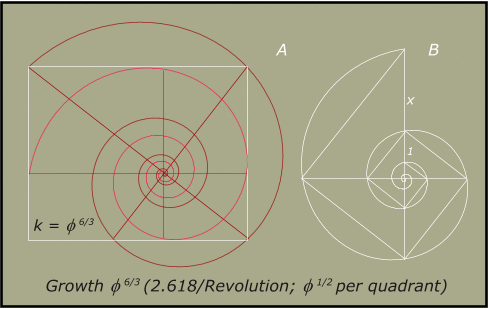
Fig. 15. The Rectangle with Inner and outer Spirals for Spira Solaris, k = Phi 2
Thus while Figure 15 is a representation of quadrantal growth that results in an increase of Phi 2per
revolution, the same delineation is also traced out by both the inner and
outer spirals associated with the rectangle. However, it is the outer spiral
that shows the fourth root increases more clearly, and both are perhaps best
demonstrated by animated graphics, firstly with respect to the original "Golden"
rectangle and the spiral k = Phi 4 and secondly with respect to the associated quadrantal radii vectores for the same spiral; see Quarteranimation I (60kb) and Quarteranimation II (117kb) respectively.
As for the "Golden Rectangle" in this particular context,
one of its main values would appear to be that it provides a natural lead-in to the above
because of the close fit between the quarter-circumferences
and the spiral k = Phi 4. But as the animations show, it is neither the rectangles nor the squares
that are rotating, but the effects of spiral growth that the latter approximates
so well in this particular example.
Once the concept is understood, however, it may be extended to any and
all pheidian spirals, which was in fact how the double spirals shown
in Figures 1a and 1b were initially generated.
The above excerpt is from The
Pheidian Planobidae: http://www.spirasolaris.ca/sbb4d2c.html
John N. Harris, M.A. (CMNS).
September 10, 2002