

OVERVIEW
SPIRA SOLARIS:
Form and
Phyllotaxis Assigned
to the main heading SPIRA
SOLARIS this January 2007 essay owes its
origins to a number of events and issues, but the subtitle
itself (Form and Phyllotaxis) arises from the neglected Solar
System researches of American
mathematician Benjamin Peirce (1809-1880). His investigations and
conclusions resurfaced in September 2006 after the elevation
of the asteroid Ceres and simultaneous demotion of the planet
Pluto to the status of "Dwarf Planets." Essentially,with
Pluto
thus demoted Neptune once more becomes the outermost planet, as Peirce
stipulated on
theoretical grounds over 150 years
ago. First
published in 1850
and later recorded by his friend Louis Agassiz (1807-1873) in the
latter's
famousEssay on
Classification (1857:131)
Peirce theorised that "there
can be
no
planet exterior to Neptune, but there may be one interior to Mercury."Revisiting
my
own attempts to come to terms with the fundamental
structure of the Solar System in the first three sections of Spira Solaris
Archytas-Mirabilis
similarities between the
two approaches now
suggested
that while I had
unknowingly followed Peirce by omitting Pluto and adding an
inter-Mercurial object, I had missed the point completely when it
came to the significance of Neptune. Not so Benjamin Peirce.
Nevertheless, although Agassiz
provided additional details in his Essay
on Classificationconcerning
the latter's
Solar
System research including "the
ratios of the laws
of phyllotaxis"
in this same astronomical context, Peirce's major conclusion was cast
aside despite its potential significance. Although not stated in
these precise terms, it was
nothing less than the perception that
The
Solar System is
Pheidian in Form1and
Phyllotactic2
in Nature
Just how
right (or wrong)was Benjamin Peirce
concerning
the phyllotactic aspect of the Solar
System? He was certainly
one of the leading scholars of his day, and there is little doubt that
he
was also an influential scientist in his own right, as
the
following
excerpts from his Scientific
Biblography
attest:
PEIRCE,
BENJAMIN
(b.
Salem,
Mass., 1809; d. Cambridge, Mass., 1880), mathematics, astronomy.
Graduated from
Harvard (1829;
M.A.,1833), where he was a tutor (1831-33) and professor (1832-80). In
mathematics, he amended N.
Bowditch's translation of Laplace's Mechanique
celeste
(1829-39);
proved (1832) that there is no odd
perfect number with fewer than four prime factors; published popular
elementary textbooks; discussed possible systems of multiple algebras
in Linear
Associative Algebra ... and
set forth, in A
System of Analytic
Mechanics (1855),
the
principles and methods of that science as
a branch of mathematical theory, developed from the idea of the
"potential." In astronomy, he studied comets; worked on revision of
planetary theory and was the first to compute the perturbing influence
of other planets on Neptune; and worked on the mathematics of the rings
of Saturn, deducing that they were fluid. From 1852 he worked with the
U.S. Coast Survey on longitude determination, ... became head of the
survey (1867-74) (and) superintended measurement of the arc of the
thirty-ninth parallel in order to join the Atlantic and Pacific systems
of triangulation. Influential in founding the Smithsonian Institution
and the National Academy of Sciences. (Concise
Dictionary of
Scientific Bibliography,
Charles Scribner, New York
1981:540)
For my
own part, I intend to show
in this title
essay that Benjamin Peirce's phyllotactic approach to the structure of
the Solar system was indeed correct, all
ramifications and consequences notwithstanding. In
short, the
long-delayed
legacy of Benjamin Peirce
and the policies laid
out in his
closing remarks to the
members
of the American
Association for the Advancement of Science concerning the
founding of the Smithsonian
Institution, and not least of all, the honest, unhindered pursuit of
knowledge:
"Let us profit by the example of Smithson,
and, instructed by the wisdom of this
high-minded son of England, learn to confide in our own rulers. Let us
be aroused to an
earnest and harmonious effort to accomplish the plan proposed by our
President at
Albany, for the building up of an "institution for science,
supplementary to existing
institutions, to guide public action in reference to scientific
matters." With the details of the
plan and the arguments in its favor you are familiar. You know how
useful it would be as
a protection from the wasteful expenditure upon abortive attempts to
reverse the laws of
nature. You know how much it is required to sustain the purity and
independence of
science, even within its own proper domain. You know that in no age or
country was there
ever a more urgent call for a scientific society, in which scientific
influence should
predominate, where it should not be smothered by excess of patronage,
and whence it
should not be liable to banishment through any spirit or form of
ostracism. If American
genius is not fettered by the chains of necessity, and helplessly
exposed to the assaults
of envious mediocrity, but is generously nourished in the bosom of
liberty, it will joyfully
expand its free wings, and soar with the eagle to the conquest of the
skies."
Concluding remarks from "The
Address of
Professor Benjamin Peirce, President of the American
Association for
the Year 1853, on retiring from the duties of President"
"Printed by Order of
the Association" (1853:16-17)
SPIRA
SOLARIS:
Form and
Phyllotaxis
Form
1.
Form: Pheidian growth per
revolution, etc.,
phyllotaxis
phyllotaxy
noun
2. phyllotaxes, phyllotaxies
The arrangement of leaves on a plant stem.*
The
1853 Address of
Benjamin Peirce (PDF: 80kb; also in
HTML)
PART I
The Pierce Planetary
Framework (1850) Revisited. (1.272 Mb).
The inclusion
of
mean synodic periods
between adjacent planets completes a stalled 19th Century model of the
Solar System developed by American Benjamin Pierce (1809-1880). The
model suggests that the Solar System may have been subject to
disruptions in the past including the Mars-Jupiter gap, and also that
at present
Earth occupies
an intermediate, synodic location
between Venus and Mars, albeit not precisely. (Part I, Figure 1).
The resulting framework also suggests that complex elements of the
Fibonacci series, Lucas series and
Phi-series may underlie the
dynamic structure of the Solar System. As a result, with twice the
number of planetary periods now available, the incorporation of these
three series and the synodic cycles permits the development of a
working planetary framework for general testing. A search for
further enlightenment leads to Babylonian astronomy and a wider ranging
series of of inquiries with positive and negative results sufficient
enough to merit the inclusion of an
optional
excursus with Part I if
required.
OPTION Part I plus Historical
/mathematical Excursus (1.313 Mb).
PART II. The Pierce Planetary framework and
External Systems. (313 Kb).
The
revised framework was applied to a variety of external planetary
systems with similarities encountered (
e.g.,
in the structure of HR 8799) explained in part by synodic relations
common to the Solar System inherent in the
Phi-series. Other similarities
between HR 8799 and the SolarSystem include the possible demise of the
fifth planet and possible outward shifts by both HR 8799d and HR 8799e
to intermediate, synodic locations. A theoretical inward extension for
this system results in a period of 0.2405942 years (HR 8799_9)
versus 0.24084445 years for the
Solar System’s Mercury (planet #8). (Part II, Figures 1 & 2).
PART III. Real-time Motions in the Solar System and the
Golden Ratio. (3.284 Mb).
Further tests
lead to real-time planetary motion in the Solar System with results
which confirm
pheidian
similarities already encountered with the mean periods in Part I
including historical aspects explored at length in the optional
excursus. Further concerns regarding possible 795-year cycles for
the four major superior planets gives rise to the suspicion that such
matters may have significant implications;
phyllotaxis in such contexts is
also considered. (Part III, Figs.1- 6e).
PART IV. The Fibonacci series, the Lucas
series and Platonic Triangles. (477 Kb).
Searching for
enlightenment Part IV deals with the two triangles in Plato’s
Timaeus, the
isosceles and the
equilateral triangles. It is shown
the former pertains to the
Fibonacci
series, the latter to the
Lucas series and both with respect to the “Rotation of the
Elements.” Again the results are
pheidian
and again apply to similar planetary frameworks. (Part IV, Tables 1
& 2).
PART V.
Time and Tide: The Spiral Form
in
Time and Place. (15.756 Mb).
The spiral form
in time and place remains pheidian in form and interest while initially
concentrating on ammonites, where David Raup’s neglected researches are
re-examined and re-applied to ammonites after developing a series of
double-precision pheidian test spirals. Later the study widens to
include radiolarians and diodoms, but ends with concerns wihich are not
so much about the Solar System and exoplanetary systems
per se - but ourselves, our past,
our present, and our increasingly uncertain future. With this in mind,
a gentle, non-destructive option is suggested for those who might wish
to embrace it.
( jnh, 21 December 2023 ).

THE
EXPONENTIAL PLANETARY FRAMEWORK: METHODOLOGY AND DATA
Bode's Flaw
Bode's "Law" - more correctly the Titius-Bode relationship - was an
ad hoc scheme for approximating mean planetary distances
originated by Johann Titius in 1866 and later popularized by Johann
Bode in
1871. The " law " later failed in the cases of the outermost
planets Neptune and Pluto, but it was flawed from the outset with
respect to distances of both MERCURY and EARTH, as Titius was perhaps
aware.
II
The Alternative Describes an alternative approach to the structure
of the Solar System
that employs logarithmic data, orbital velocity, synodic motion, and
mean
planetary periods in contrast to ad hoc methodology and the
use
of mean heliocentric distances alone. Previous version:
http://www.spirasolaris.ca/sbb4b.html
]
III
The Exponential
Order The constant of linearity for the resulting planetary
framework is the
ubiquitous constant Phi known since antiquity. Major
departures
from the theoretical norm are the ASTEROID BELT, NEPTUNE, and EARTH in
a resonant synodic position between VENUS and MARS.
[ Previous version:
http://www.spirasolaris.ca/sbb4c.html
]
THE
SPIRAL FORM AND UBIQUITOUS GOLDEN SECTION
IV
Spira Solaris
Archytas-Mirabilis Most suitably represented in terms of
exponential growth and a complex
equiangular spiral, the Phi-series based planetary model
appears
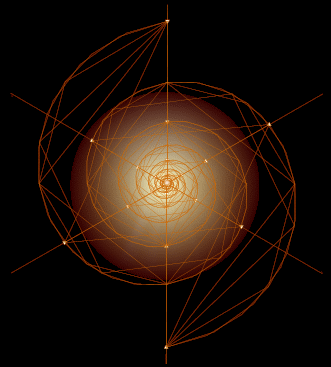
to be new in one sense and yet quite ancient in another. Title graphic (91
kb, best viewed at 1280 x 1024 resolution).
Historical
Digressions on the
Golden Section
IVd2
Spira Solaris and
The Middle Ages Ostensively the translation of Aristotle's De
Caelo from medieval latin to French, Nicole Oresme's Le Livre
du
ciel et du monde [ ca.1375 CE] was more than a translation and a
commentary.
The numerous references in this work to the insights of the Arab
scholar
Ibn Rushd [Averroes,1128-1198 CE] lead back to Plato's Republic,
Archimedes, Pythagoras, and the Golden Section in
early
Alchemical contexts.
THE
SPIRAL FORM AND NATURAL GROWTH
IVd2b Spira Solaris
and
the 3-Fold Number "The three-fold number is present in all things
whatsoever; nor did we ourselves invent this number, but rather nature
teaches it to us." Haliotis
Parva and
the Golden Rectangle
IVd2c Spira Solaris
and
the Pheidian Planorbidae Applied to Nautiloid spirals, Ammonites,
Snails and Seashells. Appendix: The Matter of
Lost Light
HISTORICAL
CONSIDERATIONS
IVc
Spira Solaris, the
Fourth Planet and Fifth Element PROCLUS [ Commentary on the
Timaeus of Plato ]: "For through analogy the universe is
completely
rendered one, this having the power of making things that are divided
to be one, of congregating things that are multiplied, and connecting
things that are dissipated.
Hence theologists surveying the cause of these things in the Gods,
enclose
Venus with Mars, and surround them with Vulcanian bonds; the difference
which is in the world being connected through harmony and friendship.
All
this complication and connection likewise has Vulcan for its cause, who
through demiurgic bonds connects sameness with difference, harmony with
discord, and communion with contrariety."
V
Spira Solaris.The
Chaldean Oracles. Proclus, and Johannes Kepler Examines the
role played by the Chaldean Oracles in influencing the
Neoplatonist Proclus [410 - 485 CE] and the connection between the
latter, The Harmonies of the
World, and the Harmonic Law "conceived on the eighth day of the
third
month in the year 1618" by Johannes Kepler [1571-1630 CE].
VI
Spira Solaris and
the Universal Ouroboros Explores the historical antecedents
and the relationship between the Equiangular Period Spiral, the
Ouroboros, Alchemy, and the
Sun.
VII
Spira Solaris and
the
Three Parts of the Wisdom of the World The spiral
configuration
is found on rock art in regions as distant as Nicaragua, Italy,
Indonesia,
and the United States. It is also found on the Plains of Nazca in Peru,
on
Malta, in France, in Britain, and especially in Ireland, where a
complex
triple spiral is illuminated on the winter solstice inside the
Neolithic
Site at Newgrange. What is the significance of this complex motif, what
message
was it intended to convey, and where does the inquiry lead?
SPECULATIONS
BACK TO THE
TOP

CURACHMEN OF THE WEST
Curachmen "For nearly an
hour
the men stood waiting to launch the curach. It was blowing fresh from
the south-west, with hard squalls of wind and rain; and the breakers
came charging in, rank after rank, in unending succession. From time to
time the men would retreat before the biggest sea, afterwards shoving
their curach well out into the water again. It looked as if the
long-awaited deibhil, or
lull, would never come..." [
G. J. Marcus. The
Conquest of the North Atlantic, Oxford University
Press,
New York 1981:3-4.] (PDF: 26 kb; also in HTML)
A MACKENZIE SOUND CARVING
MacKenzie Sound
"The rock carving in this photograph was found at a remote place on the
north end of Vancouver Island about 50 miles from Alert Bay by Stephen
Lablosky of 12320 Old Yale Road, Surrey. The figures are about 8 inches
high and 1/4" deep on the face of a large granite boulder. What
interests both he and I about this carving is that it can't be Indian,
nor is it feasible that a logger would have the skill to do such work.
Because of the religious symbolism and because of the skill necessary
to carve in granite, we tend to believe that early Hudson's Bay
explorers left it ... but for what reason?" [ Charles Lillard,
"Notes
and Queries," The
Raincoast Chronicles FIRST FIVE, Numbers 2 and 4,
Edited by Howard White, 1976, 1994:91,193
]. (Single-page PDF:
167 kb; also in HTML)
MINER
BIRDS OF THE
MONTANA
Waterstone of the
Wild.
"All through the Peruvian and Bolivian Montana
is
to be found a
small bird like a
kingfisher, which makes its nest in neat round holes in the rocky
escarpments above the river. These holes
can plainly be seen, but are not usually accessible, and strangely
enough they are found only where the
birds are present. I once expressed surprise that they were lucky
enough to find nesting-holes
conveniently placed for them, and so neatly hollowed out as though with
a drill.
' They make
the holes themselves.'
The words
were spoken by a man who had spent a quarter of a century in the
forests. ' I've seen how they do it,
many a time. I've watched, I have, and seen the birds come to the cliff
with leaves of some sort in their beaks, and cling
to the rock like woodpeckers to a tree while they rubbed the leaves in
a circular motion over the surface. Then they
would fly off, and come back with more leaves, and carry on with the
rubbing process. After three or four repetitions
they dropped the leaves and started pecking at the place with their
sharp beaks, and here's the
marvelous part, they
would soon open out a round hole in the stone. Then off they'd go
again, and go through the rubbing process with
leaves several times before continuing to peck. It took several days,
but finally they had opened out holes deep enough
to contain their nests. I've climbed up and taken a look at them, and,
believe me, a man couldn't drill a neater hole !' " [ Brian Fawcett, Exploration
Fawcett.
The Companion Book Club, London, 1954:105-106 ]. HTML; also
in PDF
(88 kb). If such a bird
does exist, what might it be? A hole-making
Bolivian Ovenbird perhaps? A "Common miner" (Geositta cunicularia) or a "Puna
miner"(geositta punensis)?
PETRIE'S CORE 7
From a wider, earlier and more distant perspective there is something
else to be considered. Namely, whether the repeated
pouring of a "softening" liquid of this sort while drilling could
provide an explanation for "Petrie's Core #7,"
a slightly conical,
cyclindrical residual core drilled
from a solid block of stone block by ancient
Egyptians that requires modern power tools to emulate.
FOR
THE RECORD: WI TE MANEWHA
For the Record
"A
spendid cast of the deeply carved face of Wi te Manewha was taken by
Lindauer and Sir Walter Buller. His moko was perfect, the lines cut
exceptionally deeply, even to the eyelids. It was said that the
tattooing was done twice to make deeper markings. The cast was made
during the lifetime of the chief. It
is of considerable ethnological value because it is the only known
instance of an old-time Maori permitting such a thing, since the head
was considered sacred." [ An extract from MAORI
PAINTINGS: Pictures from the Partridge Collection of Paintings by
Gottfried
Lindauer. Edited by J. C.
Graham, A. H & A.W. Reed,
Wellington, 1956]. (HTML; also in PDF: 440 kb)
COAST
SALISH / SQUAMISH WELCOME FIGURE
Should you wander down an increasingly urban
pathway along the western
bank of
British
Columbia's Capilano River (the natural boundary
separating North
and West
Vancouver), you may come across a small inscription on a rock
by the wayside. Carved with care, it is clearly modern, inscription and
text alike. It says sadly and simply:
Strength
in your weeping,
Tears that
come seeping,
Down the old
canyons,
Back to the
sea.
From The
River by Jean Gowland
Passing under a bridge the path continues along the pavement of a road
that leads around a large Mall, where (now separated from the river by
a wire and split-board fence) the path curves south again into a small
wooded
area. Finally, one eventually reaches the rivermouth and
following the shoreline to the
west, a small bay bounded by a pair of rocky outcroppings. Augmented
and
strengthened, these too are modern, and often visited for they extend
outwards from the beach area of West Vancouver's Ambleside
Park. At the
end of the largest outcropping, however, there is another recent
inscription, this time on a bronze bi-lingual plaque. But here the text
is accompanied by something else, namely a large wooden figure looking
out over the Inlet towards the southwest with both arms outstretched.
This is the Coast Salish Welcome
Figure erected by the Squamish First
Nation to commemorate the first "Gathering of Ocean
Canoes" in
the summer of 2001.
For this is their land; this is their will,
and this is their generous
welcome.
GEORGE
WOODCOCK : PEOPLES OF THE COAST
A Witnessing "Yet it was in one way the most dramatic dance
of the whole night, for the drummers came down out of the bleachers to
join those on the floor and make an avenue of sound through which the
old dancer progressed, with hundreds of voices shouting out her song,
and her attendants scattering handfuls of coins among the drummers and
the singers. It was obviously a farewell, for we felt no doubt that
this was the old woman's last dance, and that she and everyone
else knew it. But it was also the kind of assertion of continuity, for
here was a person who had been a child in the last flourishing of the
old native culture, and by supporting her in her dance the rest of the
people were not only proclaiming their continuity with the past but
also celebrating the revival of the old ways." [A
Witnessing: The concluding chapter of George Woodcock's PEOPLES
OF THE COAST : The Indians
of the Pacific Northwest, Hurtig Publishers, Edmonton,
1977:209-214.] (HTML; also in
PDF: 56kb)
QUANTUM
ENTANGLEMENT : THE STARFISH TELEGRAPH
Quantum Entanglement:
"I hoisted the anchor and arrived at Barney's to find him collapsed
and hemorrhaging. I took him in my boat to the nearest settlement,
leaving the two starfish in a bucket of sea water in the shack. Barney
later died in the Prince Rupert hospital. When I got back to
Kettle Inlet, the starfish were dead. The water should have been
changed every twenty-four hours or oftener. The years have
passed and I've never related this story for fear that I might become a
candidate for the funny house. Quite recently I read an article similar
in regard to plants which gave me the courage to contribute my story at
this time." (C.H. Doane [ "The Starfish
Telegraph," The
Raincoast Chronicles SIX/TEN, Number 10.
Edited by
Howard White, 1976, 1994:237 ]. Single-page PDF:
29 kb; also in HTML)
THE
TIMES AND TIDES OF JOHN DAVIS THE NAVIGATOR (1550-1605)
The Times and Tides
of John
Davis: Selections
from The Voyages and Works of John
Davis the Navigator (1880). [ PDF: One page Index (as below) ]
The
original 1880 publication of The
Voyages
and Works of John Davis the Navigator, more often than not
restricted
to
Special Collections and Rare Book Departments, etc., is currently
available on the Internet as a large, graphics-based GoogleDigital PDF file.
Because of its sheer size, however, the various topics
in this 515-page volume may still tend to overwhelm the
casual
reader, especially in this particular format. For this reason, selected
segments from the above are provided here in smaller, searchable PDF
files that retain the original
antiquated English texts, typesetting and
pagination. The choice of material, however, does
not center on the voyages of
John Davis per se, but on his
use of the
heliocentric concept and the impact of this understanding on the
development of
Elizabethan navigation in general. Thus, in addition to The Worlde's
Hydrographical Discription (1595) and Seaman's
Secrets (1594,1607) by John
Davis himself the
selection includes the "Note
on the New Map" of A.
D.
1600 by Charles Henry Coote and an extensive Bibliographical
List of Works on Navigation during the Reign of Elizabeth
prepared by Albert Hastings Markham. Lastly, an additional supplement: Introduction,
Symbols and Abbreviations, and a Short Bibliography to Copernicus and
Kepler (1952) by Charles Glenn Wallis has also been included to
provide a necessary background for
the
opposing geocentric and heliocentric planetary theories of the
time. [
Sources: John Davis, Albert.Hastings Markham and
Charles
Henry Coote in The
Voyages and Works of John Davis, the Navigator,
The Hakluyt
Society, No. LIX, London, 1880.
Charles Glenn Wallis in Great Books
of the
Western
World 16, Editor-in-Chief Robert Maynard Hutchison, William
Benton, Chicago 1952:481-495. ]
WORKS
BY JOHN DAVIS:
The
Worlde's
Hydrographical Discription (PDF: 256 kb)
Seaman's
Secrets : Book I .
(Degrees, Times, and Tides, etc. PDF: 1.33 Mb)
Seaman's
Secrets : Book II.
(The Globe and Other Instruments. PDF: 1.49 Mb)
ALBERT
HASTINGS MARKHAM:
John Davis the Navigator
[Introduction plus Note and 3rd Voyage(1587). PDF: 664 kb]
Letters of Marque and
Other Matters (PDF: 61 kb)
Bibliographical
List of
Works on Navigation (PDF: 215 kb)
CHARLES
HENRY COOTE:
"Note on the New Map" of
A. D. 1600 (PDF: 113 kb)
CHARLES
GLENN WALLIS:
"Introduction to
Copernicus and Kepler, etc." (PDF: 147 kb)
RELATED MATERIAL:
The World Encompassed by
Sir Francis Drake "Collected out of the Notes of Master Francis Fletcher, Preacher in this
employment, compared with divers others notes that went in the same
VOYAGE. Printed at London
for Nicholas Bourne, dwelling
at the
south entrance of the Royal Exchange, 1652." (PDF: 856 kb)
CHARLES
LILLARD : INTRODUCTION TO WARRIORS OF THE NORTH PACIFIC
" Now that there is no longer a western frontier, we are slowly
recognizing the American "melting pot" and the Canadian "mosaic" for
what they are, stewpan and collage. Also, we are learning our ancestors
rode roughshod over the land with little consideration for the future.
They took the land, built their towns and villages, and then, knowing
they had civilized a new world, died. What we are no longer sure of is
our own place in this new world of theirs. The question asked by
Margaret Atwood in Survival belongs
to all of us: "what do you do for a past if you are white, relatively
new to a continent, and rootless?" Personally, I doubt anyone
will answer Atwood's question satisfactorily. The wording is too
exquisitely subjective, every answer leads to a new question. A maze
this large and confusing suggests we no longer believe in the Noble
Pioneer, this creature has gone the way of the Noble Democrat and the
Noble
Savage -
older
myths created by
earlier North American
historians.
If this is so, is it not possible that the history we have learned from
our text books, this history we call ours, may be ambiguous? [ Charles
Lillard: Introduction to WARRIORS OF THE NORTH PACIIFIC: Missionary
Accounts of the Northwest Coast, the Skeena and Stikine Rivers and the
Klondike,
1829–1900,
Edited
and Annotated by Charles
Lillard,
Sono Nis Press, Victoria, B.C. 1984:10. PDF: 124 Kb;
also in HTML
]
CHARLES
GLENN WALLIS:
BACK TO THE
TOP

TIME SERIES ANALYSIS
Times Series Analysis.
The advent of modern computers permits the investigation of planetary
motion
on an unprecedented scale. It is now feasible to treat single events
sequentially and apply detailed time-series analyses to the results;
also in PDF.
TIME
SERIES GRAPHICS
Time Series Graphics
Examples of chaotic and resonant planetary relationships in the Solar
System and
a possible link with Solar Activity.
THE
TYRANT'S NUMBER
The
Tyrant and the Bride
The Number of the Tyrant is 9. What is the Number of the Bride?
Plato's Republic is an enduring and much admired work, but the problems
presented here have still confuted hundreds, if not thousands of
inquiring minds since Plato's time [427-347 BC]. So be forewarned, this
is not a simple
matter; nor is it a matter of simple arithmetic, either. Clues abound
everywhere, but watch for phantoms and misdirections nevertheless.
(HTML). March 2019 expanded version in PDF: 561 kb)
PYTHAGOREAN
FRAGMENTS
Pythagorean Fragments
Selections from the Doxographers, Fragments of Philolaus, Fragments
of
Archytas, Metaphysical and Political Fragments. (HTML; also in PDF: 204 kb)
QUINTESSENTIAL
JACK LINDSAY
Time and Eternity
II
(HTML; also in PDF:
48 kb)
"Time
is the moving image of Eternity,
Plato remarked among the Stars.
Eternity is the sudden wholeness of Time,
Apollo answers amid the Flowers."
The first
and concluding chapters from The
Origins of Alchemy in Graeco-Roman Egypt by Jack Lindsay,
Ebenezer Baylis and Son, Trinity Press, London 1970 ( PDF: 230 kb).
THE
STAR OF BETHLEHEM AND BABYLON
The
Star of Bethlehem and Babylon From a technical viewpoint the
detection of the faint but
unquestionably visible planet URANUS by Babylonian astronomers in 9 BC
provides one of
the more logical mechanistic explanations for the phenomenon. A
non-denominational discourse for open minds.
BABYLONIAN
MATHEMATICS AND
SEXAGESIMAL NOTATION
Babylonian
Mathematics
and Sexagesimal Notation Base-60 has its advantages, e.g., the Maya
relationship of 81 synodic months = 2392 days results in a decimal
value of 29.530864... days for the mean synodic month. In Base-60 it is
exactly 29;31,51,6,40 days
(the modern estimate is 29;31,50,7,30 days) as opposed to the rounded
Babylonian estimate of 29;31,50,8,20 days. The latter, allied with the Babylonian mean sidereal month of 27;19,18 days
produces an excellent value for the sidereal year (essentially the heliocentric motion of Earth
in this context) of 365.25647 days
(the modern estimate is 365.25636
days). For more concerning this calculation and additional lunisolar
cycles see the limited introduction to "Babylonian Planetary Theory and
the Heliocentric Concept" below.
MATHEMATICAL ODDITIES
At present a number of oddities remain in the
mathematical cuneiform texts of the Old Babylonian Period (1900
BCE-1650 BCE). Included here is an identical yet apparently redundant
operation in
procedures dealing with the determinaton of the cube roots of the
integer square
numbers: 27, 64, 125 and 216 (Kazuo Muroi, "Extraction of Cube Roots in
Babylonian Mathematics," Centaurus,
Vol. 31,1989:181-188; see also Abraham Sachs, "Babylonian Mathematical
Texts II-III," Journal of Cuneiform
Studies, Vol. 6, No,
4, 1952:151-155; VAT 8547 and YBC 6295). Either way there is something
to be said for repetition, especially
concerning squares and cubes, with not only tables of both attested for
this earlier period, but also tables of fractional exponents
and (apparently), even logarithms (MLC 2078, Neugebauer and Sachs, Mathematical Cuneiform Texts,
New
Haven, 1945:33-34). At the
other end of the scale is "Plimpton
322," an exceedingly complex
Old Babylonian text that "tabulates the answers to a problem containing
Pythagorean numbers (or Pythagorean triangles)" considered to be "the oldest preserved document
in number theory." (Neugebauer and Sachs, Mathematical Cuneiform Texts,1945:38-41).
JORAN
FRIBERG (2005, 2006, 2007)
In contrast to the limited selection mentioned above the
following wide-ranging collations and commentaries on Babylonian mathematics provide not only additional material, but
also a major expansion of the historical, cultural
and scientific complexities that attend this matter.
Friberg,
Joran.
Amazing Traces of a Babylonian Origin
in Greek Mathematics (World Scientific Publishing, Singapore,
2007).
Friberg,
Joran. A Remarkable
Collection of Babylonian Mathematical texts (Springer, New York.
2006).
Friberg, Joran. Unexpected
Links between Egyptian and Babylonian Mathematics (World
Scientific Publishing, Singapore, 2005).
THE OPEN UNIVERSITY
BABYLONIAN
PLANETARY THEORY AND THE HELIOCENTRIC CONCEPT
Babylonian
Planetary Theory
INTRODUCTION. Over the past century or so the parameters and
methods of Babylonian planetary theory have been gradually assembled
from the analysis of astronomical cuneiform texts from the Seleucid Era
(310 BCE-75 CE). Unfortunately, such texts do not belong to a carefully
preserved, well-organized library replete with a detailed description
of the underlying theory. Nevertheless the available cuneiform texts -
often
damaged and scattered - have yielded perhaps an end product in
the form of ephemerides for the Sun, Moon and the Planets and a
collection of "procedure" texts that describe how the mean
parameters and varying motions were determined and applied.
Although not fully explained in modern terms the latter have been
described in considerable detail, notably in Otto Neugebauer's largely
unreadable Astronomical Cuneiform
Texts (Lund Humphreys, London, 1955); in related sections of
the latter's A History of Ancient
Mathematical Astronomy
(1975); in Science Awakening II
(Bartel van der Wearden, 1978); and more recently in The Babylonian Theory of the Planets
by Noel Swerdlow (1998). Still difficult to comprehend, further
information has been published in various
Journals, especially The Journal of
Cuneiform Studies (JCS)
with additional contributions by Otto Neugebauer, Abraham J. Sachs,
Asger
Aaboe and others.
Beyond such specialised attention
the subject of Babylonian astronomy seems to have been of little
interest in this modern age, largely (one might suggest) because
researchers have consistantly
treated the subject from a non-fictive, non-model viewpoint. Given the
limitations posed by partial recovery and lack of historical guidance
this is perhaps understandable, but whether this
negative viewpoint should have persisted so long is another matter.
Against this complaint a number of reasons can be offered to explain
the apparent stagnation, including an unduly cautious approach
influenced in part by the terminology and the unfamiliar methodology adopted by the
Babylonians themselves. And also, perhaps, a general unwillingness to apply
"Occam's Razor" to the impressive
simplicity of the Babylonian methodology reinforced (consciously or
unconsciously) by "Temporal
Racism," i.e., premature dismissal based on the belief that "They
(whomever) could not know that,
or do this (whatever) in those days (whenever)."
But
this said, it also seems likely
that
at least part of the
current stagnation arose from insufficient "prior analytics," including
failure to consider the various complexities and attendant
sidereal components inherent
in the Babylonian treatment of mean and varying synodic motion.
Moreover, the fundamental parameters of time
and motion applied in Babylonian planetary theory were also (it would
seem) not fully defined in either modern or ancient contexts.
Why was this material not taken
more
seriously? Perhaps the unusual
methodology, unfamiliar terminology, and - not least of all - the
sexagesimal
system
applied well beyond modern usage. Thus not simply the "minute"
and the "second," but sequentially on down through the "thirds",
"fourths", "fifths" and
"sixths," etc., and not only for units of time and degrees of motion.
The general application of base-60 is not particularly difficult, just
unfamiliar territory at first acquaintance, but in the pre-computer era
of the twentieth century it was likely still somewhat difficult to
handle in this specific context. On the other hand, Babylonian
use of 360
degrees for revolutions,
rotations and subdivisions of the same causes no difficulty since all
have been retained to the present
day, albeit occasionally defaulting to decimal values at the lower end (e.g.,
time-keeping, latitudes and longitudes, etc.)
BABYLONIAN
MONTHS AND MEAN LUNI-SOLAR CYCLES
Babylonian concerns with varying
motion seem to have followed from the determination of accurate mean values for
all four types
of month. Thus 29;31,50,8,20 days for the Mean synodic month,
27;33,16,20 days for the Anomalistic month; 27;19,18 days for
the Mean sidereal month and
27;12,43,56 days for the Draconic
month. It is not thought that the Babylonians possessed a
value for the Tropical month, but nevertheless additional values
inherent in the Babylonian material can be
suggested.
More generally, a year of 365.256469 days
(essentially the heliocentric motion of Earth)
is readily obtained from the
application of the general synodic formula
(the product of two periods divided by their difference) to the
Babylonian mean synodic month (MSM) and mean sidereal month
(MSID), i.e, the relation (MSM*MSID)/(MSM-MSID). In identical manner
the Babylonian Mean synodic month and Draconic month yields an eclipse
cycle of 346.616572 days
(modern
estimate: 346.62005 days). Finally, in the same way the Babylonian
Anomalistic month produces a Babylonian
anomalistic cycle of 411.78054 days (modern:
411.78387 days). Although far more can be said concerning Babylonian
methodology and parameters in this context the details are at present
best left to
discussions concerning the Babylonian Lunar texts. In short,
however, in addition to the possible availability of
the above set as well as both mean and varying values, Babylonian
interest in the various complex motions of
the Moon and the 18.6 year "Saros" cycle is generally accepted,
but perhaps still not fully understood.
BABYLONIAN LONG PERIOD RELATIONS
There seems little doubt
that fundamental period
relations played a pivotal role in Babylonian planetary theory, and
also,
that these periods could
have been determined in perhaps a century or less of
continued observation. It could also have
taken considereably longer, but nevertheless ample time exists from the
beginning
of the Old Babylonian Period (1900 BCE-1650 BCE) down to the much later
Seleucid Era (310 BCE-75 CE). Moreover, although no comparable
astronomical texts from the earlier period have been recovered, there
is nothing of
a
mathematical nature lacking
in the Old Babylonian Period. As it is now - perhaps more a
function
of
partial recovery than anything else - it is the material in the
astronomical cuneiform texts from the latest
era that contain the methodology and the details applied so
successfully in Babylonian astronomy.
For the superior planets Mars,
Jupiter and Saturn It is
known that Babylonian astronomers employed disarmingly simple "Long"
integer
period relations derived from pairs of near-integer
periods with corrections of opposite sign to obtain an integer period
in years to which corresponded an integer number of revolutions
(sidereal periods) and corresponding numbers of synodic
periods.
Thus, as stated in Section 1 of No. 813, a Babylonian procedure text
for Jupiter (Neugebauer, Astronomical Cuneiform Texts,
1955:402, translation by A. Sachs)
with decimal values substituted for
clarity the following instructions and results for this planet:
"Compute(?) for
the whole zodiac (or for each sign) the according to the day and the
velocity.
in 12 years you add 4;10, in 71 (years) you subtract
5, in 427 (years) longitude (returns) to its (original) longitude."
provide the following fundamental relationships for the
determination of the mean
synodic arcs from the division of the total sidereal motion by the total
numbers of synodic events (thus both the mean synodic arc and also the
mean synodic period):
JUPITER: 427 Years, 36
Sidereal Revolutions(36 x 360
degrees) and 391 Mean Synodic Arcs .
SATURN: 265 Years, 9 Sidereal
Revolutions (9 x 360 degrees) and
256 Mean Synodic Arcs.
MARS: 284 Years, 151 Sidereal Revolutions (151 x 360
degrees) and 133 Mean Synodic Arcs.
Needless to say, if required, the mean sidereal arc
could just as easily be obtained from the division of the total
sidereal motion by the corresponding numbers of revolutions in all
three cases.
The simplicity of these period
relations belies their accuracy. For example, from the 284-year period
of Mars the period of
revolution is simply
284/151
= 1.880794 years (modern estimate: 1.880744
years), an impressive result given the speed and proximity of Mars to
Earth
and the eccentricity of the former in particular. Moreover, this
favourable comparison was obtained without defining the length
of the
Babylonian year. This central parameter is, unfortunately, a further
source of
complexity since it involves the motion of the moon and consequently a
year expressed in mean synodic months applied in planetary contexts.
There are better estimates for the year utilizing this parameter and
there also exist superior alternative derivations. Nevertheless,
although a little on the high side a year of 12;22,8 mean synodic months = 365.2606377 days was chosen for its mathematical convenience.
In passing it may be noted that from the above period relation for
Jupiter the mean synodic period obtained from the division of the long
period of 427 years and the total number of synodic arcs (391) yields a
value of 427/391 = 1.0920716 years. With a year of 12;22,8 months the
Babylonian rounded value for this period is given as 13;30,27,46 months
in Section 1 of Jupiter procedure text No. 812 (Astronomical
Cuneiform Texts, 1955:392-393), and though not fully completed in the text,
13;30,27,46,16,40 months in the second section to provide an
alternative approach for both the mean and varying motions of this
planet. Similar procedures were adopted for Saturn and Mars using the
same length of year, again simplicity in a practical sense, yet on a
more complex level, perhaps also resonance-related concerns embracing
both the Moon and the annual/diurnal motions of Earth itself.
BABYLONIAN
CHARACTERISTIC SYNODIC PHENOMENA
How were the planets tracked over "the whole
zodiac ... according to the day and the velocity"? As far as the above
derivation may be concerned,
although unusual at first acquaintance,
Babylonian astronomers employed five "characteristic (synodic)
phenomena" to account for the
motions of the superior planets Mars, Jupiter and Saturn as observed
from Earth, thus the apparent
synodic motion of the
planets in the
night sky. Of the five Babylonian phenomena only "opposition" remains
with us today to any extent, whereas the other four phenomena are
additional defining intervals for synodic movements that necessarily incorporate
the lap-cycles
of swifter-moving Earth. All of which in practice become further
complicated by the elliptical orbits and varying orbital velocities of not only the planets in
question, but also those of Earth itself. Nevertheless, this too was
fully addressed, again with impressive simplicity.
Precisely how, when, and where the
Babylonian approach to planetary motion
first originated remains unknown, but on examination it can seen
that
their inquiry was both logical and supremely sensible, commencing
(perhaps)
with the various motions of the two major luminaries (the Sun and the
Moon), the development of units of time and measure in this context,
and further (likely concurrent) investigation of the five visible
planets
known in Antiquity.Thus over the years, after the determination of the
mean motions and discernment of variations in position and velocity,
the establishment of the extremal synodic arcs (the maxima and minima
of Babylonian Systems A and B along with their periodic times).
In short, the establishment of a comprehensive framework for
further refinement of the synodic cycles with orbital variations
factored in for both Earth and the superior planets. Thus the eventual
ability to account for variations in repetitive synodic phenomena
throughout the entire 360-degree zodiacal round apparently observed against
reference frames provided by the local horizon and some 33 "Normal"
stars distributed
around
the plane of the ecliptic. Historically correct or otherwise, on examination there can be little
doubt that the Babylonian
characteristic phenomena so
used are
best understood in terms of a
fictive, heliocentric planetary model
that incorporates the dual west-to-east movements of Earth. Thus (1):
the west-to-east diurnal rotation
of Earth about its own axis, and (2) the
likewise orbital revolution
of Earth and the planets around the center of the Solar System with
time
variously defined (as done today) by seconds, minutes, hours, days,
months and years.
METHODOLOGY
AND OBSERVATION
Just how successful was the Babylonian
approach to the motions of the
Planets, Sun and Moon? This has yet to be fully established. However,
although not immediately obvious, the
precise determination of mean orbital velocities followed by accurate
extremal
limits and lines of apsides have sidereal equivalents that provide
room for both speculation and further expansion.
In any event, there would seem to have
been ample time available for
the development of an underlying planetary theory by the Seleucid Era (310
BCE-75 CE), based perhaps on data
obtained from an extensive
Babylonian observation program known to have extended from
approximately 700 BCE
into
the 1st Century of the
present
era. For details see the links immediately below.
ASTRONOMICAL
DIARIES AND RELATED
TEXTS FROM BABYLONIA
INTRODUCTION
to
ASTRONOMICAL
DIARIES AND RELATED
TEXTS FROM BABYLONIA (by
Abraham J. Sachs and Herman Hunger, 1984) with added notes. Updated on 31 August 2021.(PDF:1.08 Mb
kb).
Babylonian
"Normal" Stars and the Zodiac plus standard zodiacal signs
and dual
names (graphic). Single-page reference in PDF: 129 kb.).
INTRODUCTION
plus VAT4956 The Introduction plus a short
astronomical diary for the year 567
BCE. (PDF: 285 kb)
A SELEUCID TABLE
OF DAILY(?) SOLAR POSITIONS
Asger Aaboe, Journal of
Cuneiform
Studies, Volune 18, 1964:31-34. (Single-page PDF: 575 kb)
THE
TRAPEZOID IN TWO ASTRONOMICAL CUNEIFORM TEXTS FOR JUPITER
The unexplained
trapezoid in two Babylonian astronomical cuneiform texts for
JUPITER from the Seleucid Era (310 BCE-75 CE) Partial
analysis by Otto Neugebauer (Astronomical
Cuneiform Texts, 1955:405,430-31; single-page PDF, 34 kb)
JANUARY 2016
A modern, far-reaching
analysis of the trapezoid in ACT 817, ACT 813 and new related
Babylonian texts by Mathieu Ossendrijver (2016).
"Ancient Babylonian astronomers calculated Jupiter's position from the
area
under a time-velocity graph."
This is a complex treatment of a
complex matter, and also, since it is a fictive approach to Jupiter's
motion, a major step forward, especially since the data used here
has an almost certain heliocentric component.
PROJECTILES,
PARABOLAS AND
GALILEO'S APPLICATION OF THE FOURTH LAW OF PLANETARY MOTION
PROJECTILES,
PARABOLAS, AND VELOCITY EXPANSIONS OF THE LAWS OF PLANETARY MOTION
BY J. N. HARRIS. Cape Parry, N. W. T. (1989).
Journal
of the Royal
Astronomical Society of Canada, Volume 83, No. 3,
pp.
207-218,
June 1989.
[
ABSTRACT ]
"Kepler's
Third Law of planetary motion: T2
= R3 (T = period in years, R =
mean distance
in astronomical
units) may be extended to include the inverse
of the mean speed Vi (in
units
of the inverse of the Earth's mean orbital speed) such that: R = Vi2
and T2 = R3
= Vi6.
The first relation
- found in Galileo's
last major work, the Dialogues Concerning Two
New
Sciences (1638) - may also be restated and expanded to include
relative
speed Vr (in units of
Earth's mean orbital speed k) and absolute speed
Va
= kVr. This paper explains the
context of Galileo's velocity
expansions
of
the laws of planetary
motion and applies these relationships to the
parameters
of the Solar System. .. A related "percussive origins" theory of
planetary
formation is also
discussed."
The alerting material for the above paper was a critical dialogue
between
"Sagredo" and "Salviati" in Galileo's Dialogues Concerning Two
New
Sciences (1638):
"
Sagredo. Allow me,
please, to
interrupt in order that I may point out the beautiful agreement between
this thought of the Author
[Galileo] and the
views of Plato concerning
the origin of the various uniform speeds with which the heavenly bodies
revolve. The latter chanced upon the idea that a body could not
pass
from rest to any given speed and maintain it uniformly except by
passing through all the degrees of speed intermediate between the given
speed and rest. Plato thought that God, after having created the
heavenly bodies, assigned them the proper and uniform speeds with which
they were forever to revolve; and that He made them start from rest and
move over definite distances under a natural and rectilinear
acceleration such as governs the motion of terrestrial bodies. He added
that once these bodies had gained their proper and permanent speed,
their rectilinear motion was converted into a circular one, the only
motion capable of maintaining uniformity, a motion in which the body
revolves without either receding from or approaching its desired goal.
This conception is truly worthy of Plato; and it is to be all the more
highly prized since its underlying principles remained hidden until
discovered by our Author who removed from them the mask and poetical
dress and set forth the idea in correct historical perspective. In view
of the fact that astronomical science furnishes us such complete
information concerning the size of the planetary orbits, the distances
of these bodies from their centers of revolution, and their velocities,
I cannot help thinking that our Author (to whom this idea of Plato was
not unknown) had some curiosity to discover whether or not a definite
"sublimity" might be assigned to each planet, such that, if it were to
start from rest at this particular height and to fall with naturally
accelerated motion along a straight line, and were later to change the
speed thus acquired into uniform motion, the size of its orbit and its
period of revolution would be those actually observed.
Salviati. I think
I remember his
having told me that he once made the computation and found a
satisfactory correspondence with observation. But he did not wish to
speak of it, lest in view of the odium which his many new
discoveries had already brought upon him, this might be adding fuel to
the fire. But
if any one desires such information he can obtain it for
himself from the theory set forth in the present treatment."
(Dialogues
Concerning Two New Sciences published in 1638 (translation by
Henry Crew and Alfonso de Salvio, Fourth Day,1914:261-262;
emphases supplied)
As indeed one can, once alerted to the primary source, the materials
and the
methodology provided by Galileo in the following
condensed paper published in 1989 in the Journal of
the Royal
Astronomical Society of Canada reproduced here wth the permisson
of the Editor
Velocity
Expansions of
the
Laws of Planetary Motion [HTML]
or PDF
(475 kb).
ASSOCIATED
MATERIAL
Galilei Galileo's Dialogues
Concerning Two New Sciences (1638) translated by Henry Crew and
Alfonso
de Salvio (1914).
INTRODUCTION
Title
Page, Contents, Transcriber's Notes (added) Translator's
Preface,
Introduction, Galileo's
Dedication, Publisher's Remarks and Index. PDF (929 kb).
FIRST DAY
"Treating of the resistence which solid bodies offer to
fracture." PDF (938 kb).
SECOND DAY
"Concerning the cause of cohesion." PDF (944 kb) .
THIRD DAY
"Second new science, treating of motion (movemeti locali), Uniform
motion, Naturally accelerated motion." PDF (1.2 mb).
FOURTH DAY
concerning:"Violent
motions. Projectiles." (Includes the reference to PLATO in the above
astronomical context). PDF (805 kb).
ADDED ( or
"FIFTH" ? ) DAY
from the Stillman Drake translation of the Two New
Sciences (1974). PDF (175 kb).
APPENDIX to
the FOURTH DAY also included by Stillman
Drake (1974). PDF (385 kb).
May 20, 2011 Update: With
slight modification Galileo's "percussive" theory might also be applied
to the origins of recently discovered "rogue
planets" thought at present to be roaming the universe in
surprising large numbers.
BACK TO THE
TOP

ALCHEMICAL
GOLD
Alchemy is
a
subject of which we have all heard of, and which is yet a mystery. In
some ways
it belongs to the world of mystery stories from the past. We
remember perhaps the shade and wonderful light of Rembrandt's etching
of the Alchemist, or the stories we read in Chaucer or Ben Jonson. Was
the alchemist a philosopher, deep in a mysterious study
where he discovered the secrets of transmutation? Was he just a
charlatan involved in a particularly
fantastic kind of mumbo-jumbo? Was he simply a forerunner of the
scientists of today? Or had he an occult knowledge which we cannot hope
to acquire in
our materialistic environment? [
Introduction to The Arts of the Alchemists, C.A.
Burland, 1986-1; for more on the scope and complexity of this subject
see: Timeline
of
Alchemical Books and Various Alchemical
Texts from the extensive collection of material available at the The Alchemy Web Site
]
THE MADNESS OF
MANKIND #1
3001: THE FINAL ODYSSEY
Chapter 19 "
You may have heard me called an atheist, but that's not quite true.
Atheism
is unprovable, so uninteresting... My field of interest is the
psychopathology known as Religion .... Lucretius hit it on the nail
when he said that
religion was the by-product of fear - a reaction to a mysterious and
often
hostile universe. For much of human prehistory, it may have been a
necessary
evil - but why was it so much more evil than necessary - and why did it
survive when it was no longer necessary? "[ condensed from Chapter 19:
"The
Madness of Mankind," 3001: The Final Odyssey by Sir Arthur C.
Clarke,
1997:136-142;
PDF: 27 kb ].
THE MADNESS OF
MANKIND #2
OCTOBER THE FIRST
IS TOO LATE
Grave e Mesto "
The time for departure came. We all agreed that delay would be bad. I
took one last look around. There was the electronic box, the thing I
had come to think of as a piano ... I had a strong urge to play on it
for one last time. I told the others, saying I would prefer to be
alone, that I would follow in a few minutes. Melea answered: ' Don't be
too long.
There isn't much time.' I began to play. I realized that only in music
could I find the answer I was seeking to the questions of the previous
evening.
Argument I could follow, it weighed with me, yet I could decide nothing
from it. I did not know exactly what the music was, it was an
improvisation
not so much on a musical theme as on the agony of the destiny of man. I
continued to play on and on, aware at last that I had made my
commitment. I was
playing the Schubert Andantino when Melea returned." [ The end of Chapter 14, October
the First is Too Late by Sir Fred Hoyle, 1968:158-172; PDF: 57 kb ]
JACQUETTA
HAWKES: SUN
OF INTELLECT
Man and the Sun
" In following the solar cycle of this book, I have honoured those who
worshipped the Sun God in his many forms. Yet I have also honoured
those
scientists whose probing minds have dispelled the simple divinity of
the
star. The members of the Holy Office were right to be fearful of the
ideas of Copernicus to see that they would lead to the destruction of
many of
the old religious forms. They were wrong as well as ridiculous trying
to turn back the tide of science, of man's efforts to comprehend the
physical universe, for that pursuit is a part of what is divine in
humanity. We
have to honour both the King of Heaven and Prometheus. The present
peril and
despair of humanity show that we cannot live without religious meaning
although we may do without religious institutions. (The time may come
when even
those few who still follow them turn against priests who in
gem-encrusted
copes and mitres, serve Him who taught poverty and humility, who betray
Him who taught love of one enemy by raising no murmur against a
holocaust
of hate.) If we cannot find god in the world, we lose Him in ourselves
and
become contemptible in our own eyes. We become mere statistics. For
this is
the greatest evil coming from the unbalanced Apollonian mind. Science
has
won power over the universe of matter by breaking down and down, by
numbering and measuring. So at last everything that cannot be broken
down,
numbered and measured must be deemed not to exist. Science is uniting
man with
the sun in a totality of energy and matter. That is communion at the
lowest
level of being. But we have always been right to seek it also at the
highest." [ Quotation
from the
concluding chapter of Man and the Sun
by Jacquetta Hawkes,
1962:239-241. Also in PDF ]
THOMAS
CAHILL : THE HINGES OF HISTORY
The Hinges of
History (1995). "As
we, the
people of the First World, the Romans of the twentieth century, look
out across our Earth, we see some signs for hope, many more for
despair. Technology proceeds apace, delivering the marvels that knit
our world together-- the conquering of diseases that plagued every age
but ours and the consequent lowering of mortality rates, revolutions in
crop yields that continue to feed expanding populations, the
contemplated "information highway" that will soon enable all of us to
retrieve information and communicate with one another in ways so
instant and complete that they would dazzle those who built the Roman
roads, the first great information system." [ Rationale and closing
paragraphs from HOW THE IRISH SAVED
CIVILIZATION: The Untold Story of Ireland’s Heroic Role from the Fall
of Rome to the Rise of Medieval Europe by Thomas Cahill, 1995:
216-218 ] PDF: 3
pages,
75 kb .
ALEXANDER
THOM: MAN, MEGALITHS AND STATISTICS
"For
over forty years Alexander Thorn, Emeritus Professor of Engineering
Science and Emeritus Fellow of
Brasenose College, Oxford, has surveyed and planned stone circles and
other prehistoric settings of standing
stones in Great Britain and Brittany. He was assisted by his son, Dr.
Archibald Stevenson Thorn not only in the
surveying but also in the preparation of many of the subsequently
published papers. His standards of planning
have been far higher than those of the average archaeologist and
certainly superior to most of the 19th
century
antiquarians whose plans of circles were often inaccurate and slipshod.
It has been the misfortune of those
interested in megalithic rings that often only such inexact plans have
been available. For a good plan three criteria apply. The survey itself
must have been precisely done, using adequate
equipment, measuring to several points around each stone at ground
level; an accurate scale must be provided
on the drawn plan; and True North must be shown, preferably towards the
top of the page. Alexander Thom's
plans fulfil all these conditions and they must be regarded as the
finest and largest collection of stone circle plans
ever assembled by an individual. Yet many of them have never been
published. Others have been so reduced that their value has been
diminished. Consequently, all his plans of British circles have been
gathered together here, nearly always one to
a page with an accompanying text opposite giving information about the
site. The only omissions, at Thom's
request, are the Callanish rings, recently surveyed by the Geography
Department of Glasgow University, and
Stenness of which a plan has been published in the Proceedings of the Society of
Antiquaries of Scotland 107,
1978.
The resulting collection of plans should be invaluable to anyone
wishing to study stone circles.
During his researches Professor Thorn concluded that the prehistoric
builders of these rings used an almost
universal unit of measurement, the Megalithic Yard of 2.72 ft or 0.83
metres; sometimes laid out non-circular
rings in flattened circles, ellipses, egg-shapes and compound figures
whose construction was based on the
understanding and use of right-angled triangles with integral sides;
and had an empirical knowledge of
astronomical phenomena. The plans usually include the geometry Thorn
has deduced for the sites, and the
accompanying notes contain Thom's conclusions about the lengths of the
diameters and sometimes the
astronomy, if any, for each ring. These
ideas remain contentious but this book is not concerned with the
controversy. None of it detracts from
the excellence of the plans, over 200 of them, which will be
indispensable for anyone researching the British
stone circles." [
Aubrey Burl, introduction to Megalithic
Rings: Plans and Data for 229 monuments, by A.
& A.S. Thom, collated, with archaeological notes by Aubrey Burl, BAR International Series 81,
Oxford, 1980.
].
Alexander Thom's statistical methodology (including Broadbent's
Criterion),
background materials, analyses and far-reaching
conclusions were published in Megalithic Sites in
Britain
(1967, 1971).
Details
from the latter work are provided below for
those who might wish to judge this complex matter for themselves:
PART
1: Introduction,
Statistical, Mathematical and Astronomical Backgrounds, Megalithic
Yard, Conclusions.
(PDF,
4.10 Mb).
PART
2:
Circles, Rings, Megalithic
Astronomy. (PDF, 4.80 Mb).
PART
3: The
Calendar, Indications of
Lunar Declinations. (PDF, 2.93 Mb).
PART
4: The
Outer Hebrides, A Variety of
Sites. (PDF, 3.43 Mb ).
APPENDIX: A Remarkable 4000 Year-Old Egyptian
Ship with hinged, portable A-frame mast, dual-purpose sail and
other sophisticated
features.
Single page Graphic
with text
(PDF);
also in HTML.
JACK
ANAWAK AND THE 1993 NUNAVUT LAND CLAIMS AGREEMENT
Jack Anawak,
MP for Nunatsiaq (Hansard,1993):
" The history of this land claim goes back many years. It spans several
federal governments and numerous ministers of Indian and northern
affairs. Very few people realise that prior to 1973 the Government of
Canada did not have a policy to negotiate land claims. It was the
current leader of the opposition, under whom I am proud to serve, who,
when he was Minister of Indian Affairs and Northen Development, brought
forward the first policy to negotiate and resolve land claims. In
1975 the Inuit of Nunavik achieved the James Bay and Northern Quebec
Agreement. The following year, in 1976, the Inuit of the Northwest
Territories, as represented by the Inuit Tapirisat, presented their
land claim to the federal government for negotiation. Their submission
included the proposal for the creation of the Nunavut Territory. The
claim proposal was subsequently revised in 1977. In that same year, the
Inuvialuit of the western Arctic filed their own land claim. In 1978
they signed an agreement in principle with the federal government and
the final agreement was reached in 1984. Between 1976 and 1978 the
Inuit of the central and eastern Arctic experienced difficulty with
their negotations. There was an impasse over dealing with Nunavut at
the land claims table. In 1980 a breakthrough was achieved. Agreement
was reached to deal with
the Inuit proposals on Nunavut through a political development process
in the Northwest Territories separate from but parallel with the land
claims negotiations. In 1982 the Tungavik Federation of Nunavut was
formed for the specific purpose of negotiating the Inuit land claims.
In April 1990 an agreement was reached. Article 4 of that agreement in
principle affirmed federal, territorial and Inuit support for the
creation of Nunavut as soon as possibler. In December 1991 negotiaitons
were finalized on outstanding items in the land claims, including the
creation of Nunavut. In November 1992 the Inuit of Nunavut voted to
ratify their agreement.
It has been a long journey
filled with many
rough spots and roadblocks. I want to focus now on the actual
land claim and some of the obstacles the Inuit encountered in their
negotiations with the government. From the beginning the government set
out all kinds of preconditions and restrictions. In return the
Inuit were more than generous. Some of the comments I am about to make
I have made on other occasions over the past several years and many of
the people listening or watching today will be familiar with them.
However, I feel I must restate them for the record. First. I want to
take issue with the term "land claim". It is highly
inappropriate. I wish there were a better term to use but I will try to
explain what I mean by inappropriate. When aboriginal peoples talk
about their lands, we are talking about
our homelands. We are talking about the territories and resources upon
which our people have survived for thousands of years. We are talking
first and foremost about our cultures and our way of life on these
territories. The land, the waters, the wildlife, and we the people, are
one and the same. We are not separate from our environment. We are part
of it, and it is part of us. Yet non-aboriginal governments have looked
upon land claim negotiations as real-estate transactions.This is not
our view. It is difficult for us to understand the non-aboriginal
concept of individual land title and ownership. We see
these negotiations primarily as the means to preserve our
relationship with the land and ensure our survival as peoples in the
larger society surrounding us. Therefore we are also talking about
economic and political power. We require the economical and political
means to control what happens on our lands. In claim negotiations Inuit
peoples are not seeking someting that someone else already owns. We
dispute that implication. We are not asking the government to give us
something that does not belong to us. We are only seeking recognition
of what is rightfully ours. We are trying to take back what was taken
away from us by governments without consent in the past. We are
reasonable peoples. We have always been willing to share
our lands and our resources. We recognise that all peoples and all
governments must work together for the benefit of all. This is why
Inuit and other aboriginal peoples have entered into land claims
negotiations . . . ."
PDF, 4.71 Mb. Note:
Nunavut means "Our Land".
Reduced English
version (5-page pdf) .
SCHOLIUM:
NEWTON'S MATHEMATICAL PRINCIPALS OF NATURAL PHILOSOPHY
Scholium:
Newton's
closing paragraph " And now we might add something concerning a
certain most subtle spirit which pervades and lies hid in
all gross bodies; by the force and action of which spirit the particles
of bodies attract one
another at near distances, and cohere, if contiguous; and electric
bodies operate to greater distances, as well repelling as attracting
the
neighboring corpuscles; and light is emitted, reflected, refracted,
inflected, and heats bodies; and all sensation is excited, and the
members of animal
bodies move at the command of the will, namely, by the vibrations of
this spirit, mutually propagated along the solid filaments of the
nerves, from the
outward organs of sense to the brain, and from the brain into the
muscles. But these are things that cannot be explained in few words,
nor are we
furnished with that sufficiency of experiments which is required to an
accurate determination and demonstration of the laws by which this
electric and elastic spirit
operates." (also in PDF)
Why did
Sir Isaac Newton end his opus
magnum in this way?
A simple statement of faith? Or was it something more encompassing?
BACK TO THE
TOP
INUKSHUK
NUMEN
LUMEN
SELECTED TEXTUAL GRAPHICS

Inuit
Wisdom: Only One Great Thing
Rumi and the
Rising Sun +PDF
Great Solitudes
+ PDF
Abide
With Me
+PDF
Sisters
of Softlight
+ PDF
The
Ten Rules of the
Canoe
+PDF
Sandburg Dream Girl
Endless Night
Real Being Stromata
The Theory of
Everything
+ PDF
The Statendam et
La
mer
Deep Contemplations
SPIRA
DELANY'S
TIME
and ETERNITY
SPIRA STARBUCKS
THE OATH
TO
INSPIRE
Believe in your Heart+PDF
Subject Not Thy mind
+ PDF
Time, Eternal,
Infinite + PDF
Only
Temperate Souls + PDF
Visions (Ode to
Scipio) + PDF
STRENGTH IN YOUR
WEEPING
THE SQUAMISH WELCOME
FIGURE
E-MAIL
*Kessinger Publishing O
Canada 2010
Quantum entanglement and
the STARFISH TELEGRAPH
DO NOT GO
GENTLE INTO THAT GOODNIGHT
John
N. Harris, M.A. Last updated July 16, 2024. Best
viewed at 1280 x 1024,10 point latin fonts, or whatever.
"
Incredulity
is given to the world as a punishment
"
Source :
The
Crowning of Nature
"
The
weary paddler resting is still ballast "
Source :

"
Criticism
Without Light Condemns Us All to Further Darkness
"







