
CLOSING
EXCERPT
PART 7: HELLULAND, MARKLAND, AND VINLAND
3F.5
THE WILD GRAPES OF
VINLAND.
Lastly, we come to
the grapes that have caused so much trouble and dispute in
the eastern context. Here once again "Occam's Razor" cuts straight
and true, for it proves quite unnecessary to consider any and all other
interpretations
or locations for the wild grapes in question. In fact,
the inclusion of "grapes" in the Sagas reinforces the suggestion that
Vinland is indeed best understood in terms of a unique ecological niche
such as that under discussion here. The choice is again precise, as is
the location. Thus, to localize matters even further, the following
quotation with its emphasis on the town of Duncan at the mouth of
the Cowichan Valley:
BERBERIS
AQUIFOLIUM Pursh.
The genus name is derived from the
Arabic 'berberys', applied to one or more species of the Mediterranean
Coast ... This fine plant is outstanding, not only for size, leaves,
and fruit, but also for its quantities of beautiful yellow flowers and
for a delicious honey-like fragrance. Moreover, when we realize that
the fruit yields a refreshing grape-like juice (when mixed with sugar)
and an excellent jelly, it becomes apparent that it ranks high among
our native plants.... Tall Mahonia ... occasionally reaches a
height of 10 feet (near Duncan, Vancouver Island). It must take
pride of place as one of our most attractive shrubs.... ' Oregon Grape
', of course, refers to the handsome clusters of dark-blue berries that
are dusted with a pale powder or bloom."... "It is well-known now as
the state flower of Oregon."
(Lewis J. Clark, WILD
FLOWERS OF THE PACIFIC NORTHWEST, Harbour Books, Madeira
Park 1998:172-173, emphases supplied).

Figure 3. " Vinland's " Tall
Oregon-grape (Mahonia
aquifolium)
Source: PLANT
TECHNOLOGY of the First Peoples of British Columbia, Nancy
J.Turner, UBC Press, Vancouver 1998:148;
(photograph included here with the permission of the University of British Columbia Press.)
As for the grapes
in the Sagas, James
Robert Enterline wrote in VIKING AMERICA (1972):
In the Saga of Eirik the
Red, after Thorhall the Hunter went off by himself, some writers have
inferred that he found grapes and ate of them, becoming intoxicated,
for he was discovered on a steep crag where:
" he lay gazing up into
the air with wide-open mouth and nostrils, scratching and pincing
himself and muttering something ."
The corresponding
situation in the Tale of the Greenlander occurs when
Tyrkir the German, after being lost in the woods and subsequently
discovered by Leif and his men, is described thus:
"First he spoke for a
long time in German, and rolled his eyes many ways and twisted his
mouth, but they could not make out what he said. After
a while he said in Norse: ' I did not go much farther, and yet
I have a discovery to tell of; I have found vines and wild grapes.'
"(James Robert Enterline, VIKING AMERICA, DoubleDay,
Garden City, 1972:38)
Enterline rejects
the "possibility of instantaneous fermentation on the vine
needed to produce such supposed intoxication", and few would
argue with this assessment. But what of the effects of eating too
many of the wild grapes that grow in the
Cowichan Valley, the suggested West Coast location for Vinland
under discussion? Here Pojar and Mackinnon (1994) note that: "The
tart, purple berries of both Oregon-grapes were eaten, but generally
not in quantity." Why not in quantity? Perhaps the following
provides the answer to both this question and the apparent
"intoxication" in the Sagas:
The bark is bright
yellow
inside, due to an alkaloid, berberine. The shredded bark of the stems
and
roots was used to make a bright-yellow dye for basket materials. The
bark
and berries were also used medicinally for liver, gall-bladder and eye
problems. One Saanich woman noted that eating the berries in
quantity was the
only antidote known for shellfish poisoning. Great
caution
was used, because this drug is very potent.
(Plants of the
Pacific
Northwest Coast, Compiled and Edited by Jim Pojar and Andy
MacKinnon, Lone Pine Publishing, Redmond, 1994:95; emphases added).
Oregon grape and
barberry plants, including the fruits, contain the alkaloid drug,
berberine, used in medicine as an astringent for treating inflammation
of the mucous membranes. This compound is potentially toxic if taken in
large does, and therefore it is recommended that you eat these fruits
and foods made from them with moderation and do not consume them as a
regular part of your diet.
(Nancy J.Turner, Adam F.Szczawinski. Edible Wild Fruits and Nuts of Canada.
National Museum of Canada, Ottawa, 1979:39-40)
Many people are very
fond of a tart Oregon Grape jelly as a condiment to use with meats.
I've never cared much for it. When my mother made it, years ago, we
kids dubbed it "quinine jelly", and we rolled on the floor in simulated
agony! Maybe Mom didn't have the right recipe. Still other people
are devotees of Oregon Grape wine. I've made it myself, and I've tasted
that made by others. Its big drawback is a pronounced earthy taste that
takes at least a year or more to age out. (J. E. Underhill, Wild
Berries of the Pacific Northwest, Hancock House,
Saanichton, 1974: 68-69)
Lastly, there remains one one loose
(and indeterminate) end concerning Mahonia
aquifolium itself. According to Pojar and
McKinnon (Plants of the Pacific Northwest
Coast,
1994:95), "Oregon Grape" ranges from Southern coastal British Columbia
to Central Oregon. More precisely, it is found in the south-east corner
of Vancouver Island as already noted, and also on the lower British
Columbia mainland as far north as Powell River; further south in
Washington State, and finally in Oregon. How Oregon Grape came to
flourish in one particular corner of Vancouver Island and this section
on the coastal mainland of North America is an ecological question that
is likely lost in the mists of time. And, it must also be stated, it is
also unlikely that it would have anything to do with historical
periods, especially those as recent as the time of the Sagas.
Nevertheless, for partial "completeness" at
least, there remains a loose (if not redundant) thread in the Sagas
that combines grapes, vines and also Viking ships, i.e., after Tyrkir the Southerner found the
"wild grapes and vines":
"Leif said to his crew:
'From now on we shall have two tasks to do and we shall alternate them
so as to do each job every other day. We shall gather grapes,
and we shall cut vines and fell timber,
to make a cargo for my ship.'
This was done. It is said that their pinnace was filled
with grapes. A full cargo was cut for the ship,
and in the spring they made ready and sailed away. Leif gave the
country a name in accordance with its resources, and
called it Vinland (Wineland)." (Helge Ingstad,
1976:41-43; emphases supplied).
Remaining entirely with the
Sagas and the limited number of Viking voyages allotted to this period,
the above provides little more than a largely redundant explanation for
the naming of "Vinland" itself. As for the implication that
attends the cutting and transportation of vines in this region, this
too remains highly controversial. However, it at least permits
differentiation between the tasks mentioned in the Sagas, and it
may not be completely out of court if the favourable conditions of
the Medieval Warm Period and the possibility of more frequent Viking
contacts in the Pacific Northwest are taken into consideration.
After all, as discussed in
earlier sections, there were -- at a conservative estimate -- two
hundred years or more (i.e.,
1050 -1250 CE) during
which near-optimal conditions for shallow-draught Viking ships may well
have prevailed along most (if not all) of the Passage.
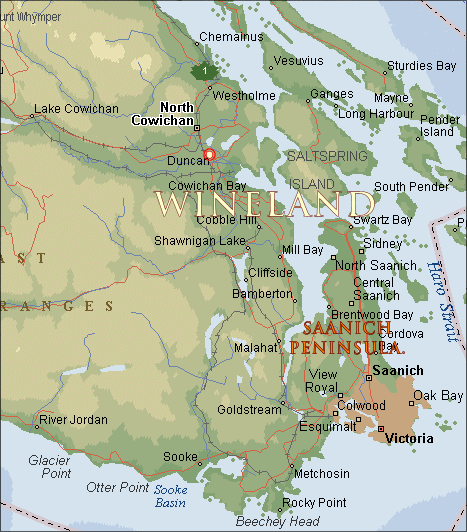
Map 8b. Wineland now, if not
Vinland then
3F.6
VINEYARDS OF THE COWICHAN
VALLEY AND THE GULF ISLANDS
Wild grapes, however, do not necessarily mean wine per
se. Then again, according to data complied by Pojar and MacKinnon
(1994:95):
"The
tart,
purple berries of both Oregon-grapes were eaten, but generally not in
quantity.
Often they were mixed with salal or
some other sweeter fruit. Today they are used for jelly,
and some people make wine from them."
Vinland indeed, it
would seem.... But in any
case, because
of its suitability, local wine from this region can in
fact
be purchased from a surprising number of wineries and vineyards
now flourishing within ten miles or so from Duncan and Cowichan Bay. By way of an introduction, the VQA (Vinter's
Quality
Alliance) pamphlet on BRITISH COLUMBIA'S WINE COUNTRY (Region
1, Vancouver Island) states:
"Situated off the
southwest coast of British Columbia, Vancouver Island is home to
the newest wine-growing region.
Just an hour's drive from
Victoria, rolling hillside vineyards
hug country lanes that connect historic towns.
Most of the 20 Hectares of
vineyards are planted near the town
of Duncan."
THE COWICHAN LAKE EDUCATION CENTRE:
"One of the Cowichan
Valley's best kept secret's is its passion for growing things in this
special place with its special climate.
The wine growers of the Valley
know how to turn the rivers and trout streams as well as clear clean
lakes into a host of fine wines and ciders.
Guests can enjoy touring Vigneti
Zanatta, Blue Grouse Vineyards, Venturi Schulze
Vineyards, Cherry Point Vineyards and the Merridale
Cidery."
The above was written in
1999. Now, only four years later, the number of wineries in the
Duncan region has grown to twelve, as detailed in a
lengthy article in an April 2003 issue of The Vancouver Sun
newspaper.
But first, remember Tyrkir the "Southerner", the discoverer of the Vinland
grapes and the vines in the Sagas?--he who proclaimed:
"I can report on
something new: I have found vines and grapes.' 'Is that true,
foster-father?' Leif said.
'It is certainly true,'
Tyrkir replied, 'for I was born where there is no lack of vines and
grapes.' "
Well read on, for the
article in question was introduced as follows:
GLENORA – They told him
it couldn't be done. A vineyard on Vancouver Island?
Impossible. Too wet. Too cool. Too this, too that. Agriculture
experts. Neighbours. Skeptics. Dionisio (Dennis) Zanatta paid them no
heed; he knew what he knew. He had grown up in northern Italy, after
all. !, Wasn't the climate similar there? Didn't they grow
grapes, make wine? “He knew that this is what they do back home,”
says Loretta Zanatta, his daughter. “Why can't you do it here?”
No reason at all, as it turned out.
Dennis
Zanatta started growing grapes and making wine shortly after he
moved to the Cowichan Valley in the 1950s to run a dairy farm.
Later, he took part in a provincial government experiment to test
new grape varieties on Vancouver Island in the 1980s. And then,
when provincial regulations finally changed, permitting small,
two-hectare wineries, Zanatta set up a farm-gate operation here, seven
kilometes southwest of Duncan. Vigneti Zanatta opened its doors to the
public in 1992, and today boasts about 12 hectares in vines, a
celebrated restaurant and a growing reputation for making fine
champagne-style wines.
It's a success story that has tilled the way for a
wine-making boom on Vancouver Island and the Gulf Islands, where
there now are 17 licensed
wineries and a cidery, five more wineries in development and plans
to double the number of hectares in production from about 105 to
more than about 202 over the next few years, according to figures
provided by the Vancouver Island Vintners Association (VIVA).
The majority of the wineries – 12 of the 23 – are located
here, in the Cowichan Valley, while the rest are scattered from
Saanich to Nanaimo to Saltspring Island.
( Lindsay Kines, “South island wine industry
booms,” The
Vancouver Sun, April 19, 2003, p.C1; emphases supplied)
By 2006 the more
comprehensive Wine
Islands Vinters Association replaced VIVA to embrace additional
wineries on the adjacent Gulf Islands; current wineries in
the immediate Duncan area are listed below in alphabetical order:
Though superceded by the Wine Islands Vinters
Association, the following quotation is retained from the original VIVA
Web pages because of its relevance to the central issue, i.e.,
the suitability of
this special region for the growing of grapes:
Southern Vancouver
Island and the Gulf Islands
comprise the warmest growing region in Canada.
The Wine Islands have their
origin in fiery volcanic
rock, and have been scoured by three ice ages.
But the ocean remained, warming the land and
creating microclimates which winemakers now
exploit for your pleasure.
This terroir
is ideal
to grow some of the world’s
best cool-climate grapes, and yields elegant,
aromatic wines reminiscent of northern Europe...
(http://www.islandwineries.ca/about.htm)
which in turn gives rise to resonant echoes of Homer's Odyssey and the "Elysian plain, which is at the ends of the world" where:
"Oceanus breathes ever with a West
wind that sings softly from the
sea, and gives fresh life to all men..."
Thus here and in general it
is hardly surprising that in 1976 Imbert Orchard used the title
“Fortunate Islands" for his Aural History impressions of
the early days on the Gulf Islands (Sound Heritage Program, Vol
5. No.4 Aural History,
Provincial
Archives of British Columbia, Victoria). An
exaggeration? Perhaps, but not necessarily. Those unacquainted with
the region might reject the notion outright, but it seems likely that
those more familiar with these warm and bountiful Islands would
nevertheless
affirm that they are about as close as anyone could hope to get.
But either way,
it seems that the Vikings knew their business when it
came to the suitability of this small region and its climate
for growing grapes.
- It is Vinland now, it was Vinland then, and quite
likely always was Fundit Vínland Góða (Vinland the
Good).

MAP 9. THE WESTERN VIKING LANDS:
HELLULAND,
MARKLAND AND VINLAND:
Helluland
commencing at the Etolin/Wrangell
Islands Region (Alaska); Markland
the Queen Charlotte
Islands, and Vinland
the
Cowichan Valley in the southeast corner of Vancouver
Island, British Columbia,
Canada. For further
information about Vancouver Island and the province of British
Columbia in general,
see the B.C.
Moments
vignettes produced by the Knowledge
Network .
POSTSCRIPT: THE CARVED SPINDLE
WHORLS
It seems entirely
appropriate to leave the present
subject with spindle whorls carved by the Coast Salish of "Vinland" and
the Pacific Northwest. The first example is described in Nancy
J.Turner's PLANT TECHNOLOGY of the First Peoples of British
Columbia, (UBC Press, Vancouver, 1998:131) as a "Coast Salish
Spindle Whorl carved from Broad-leaved Maple. The faces in the centre
are surrounded by four Mink." The accompanying photograph is shown
below with the permission of the University
of British Columbia Press.

Figure 4. The Coast Salish
Spindle
whorl
Spinning and
weaving? Yes, of course, another link,
another thread. This is after all the Cowichan Valley, now justly
famous for its "Cowichan Sweaters." And the knitting needles?
Originally made from the wood of the Vine Maple as noted earlier. But
it always was the weaving, not the knitting, and in
addition the one and the two-bar looms, the Dancing Capes and the
Ceremonial Blankets--the warp and the weave of it all...
Thus visit Duncan,
the Vineyards, and the
Cowichan
Native Village; learn the local legends, and, if it so pleases the
reader,
go there and gaze upon on "Vinland the Good," though it seems that the
Vikings
themselves have long since departed. Were they driven off, as the Sagas
record?
Or did they have their own agenda and further horizons in mind? And if so, where would they have gone next?
Who can really say. From Map 4 one might suggest south to California,
and again on to Mexico perhaps. Then Central and South America? Or did
they turn north and
west again to Siberia, China and the Far East? Unlikely scenarios?
Perhaps, but Iron Men in Wooden Ships who could navigate through the
Northwest Passage could tackle anything and go anywhere,
could they not?
And
The Last Viking?
Perhaps he lives on
in all of us.... I would like
to think so, anyway.
Finally, it seems
re-assuring, fit and proper
these days that the first Pacific Northwest Indian carvings that greet
visitors arriving at Vancouver International Airport are by the modern
Coast Salish themselves.
The
Welcoming committee - a greater than life pair of figures - Male
and Female
in balance and harmony, and in addition, a softly spiraled
spindle whorl
full sixteen feet in diameter tenderly carved in cedar.
What else remains?
Perhaps we will never know,
but then
again perhaps what was held in trust was merely a reaffirmation of
something long acknowledged and always understood.
Simply this:
Native wisdom tends to assign
human
beings enormous responsibility for sustaining harmonious relations
within
the whole natural world rather than granting them unbridled license to
follow
personal or economic whim ... Native wisdom sees spirit, however one
defines
that term, as dispersed throughout the cosmos or embodied in an
inclusive,
cosmos- sanctifying divine being. Spirit is not concentrated in a
single,
monotheistic Supreme Being ... Native spiritual and ecological
knowledge
has intrinsic value and worth, regardless of its resonances with or
"confirmation"
by modern Western scientific values. As most Native authorities would
be
quick to point out, it is quite capable of existing on its own merits
and
adapting itself over time to meet modern needs. For it is, after all, a
proud,
perceptive, and extraordinarily adaptive spiritual tradition, every bit
as
precious, irreplaceable, and worthy of respect as Christianity,
Judaism,
Islam, Buddhism, and other great spiritual traditions. (Peter
Knudtson
and David Suzuki, Wisdom of the Elders, 1992)
LUX E
TENEBRIS
RELATED BIBLIOGRAPHY
Albers, Anni.
Anni Albers:
On Weaving,
Wesleyan University
Press, Middleton, 1965.
Akrigg, G.P.V.and Helen
B. Akrigg.
British Columbia Place Names, UBC Press, Vancouver, 1988.
Allen, Oliver E. The
Pacific Navigators, with
the Editors of TIME-LIFE Books, New Jersey, 1980.Almgren, Bertil, et
al. THE VIKING, AB Nordbok,
Gothenburg 1975.
Anderson,
Stuart. "Bathurst Inlet Patrol" The Beaver, Spring
1972.
Andersson,Theodore
M. The
Problem of
Icelandic Saga Origins: a
Historical Survey. Yale University
Press, New Haven and London,
1964.
Anton, Ferdinand. Ancient Peruvian Textiles,
Thames and Hudson,
New York, 1987.
Archer, Colin. Shipbuilding
a
Thousand Years Ago. Transactions of the Institute of Naval
Architects, London, 1981.
Arnold, David."Pueblo Pottery: 2000 Years of
Artistry," National Geographic Magazine, Vol. 162, No. 5, April
1996.
Ashwell, Reg. Coast
Salish: Their Art, Culture and Legends. Hancock House, Surrey, 1978.
Bancroft-Hunt, Norman, and Werner Forman. PEOPLE OF THE TOTEM,
DoubleDay Canada, Toronto, 1979.
Barbeau, Marius. Totem Poles According to Crests and Topics,
Canadian Museum of Civilisation, Hull, 1990.
Barreé
Bawlf, Samuel.The
Secret Voyage of
Sir Francis Drake 1577-1580, Douglas &
Mclntyre, Vancouver,
2002.
Bentley, Ted and Mary
Bentley. Gabriola: Petroglyph Island,
Sono Nis Press, Victoria, 1998.
Berton, Pierre.The Arctic Grail, The Quest for the North West
Passage and the North Pole, 1818-1909, Anchor Canada,Toronto 1988.
Bibeau, Pierre. Établissements
paléoesquimaux du site
Diana 73, Ungava.
Montréal, Laboratoire d'archéologie de
l'Université du Québec à Montréal, coll.
Paléo-Québec No. 16, 1984:167.
Blackman, Marget B. "Hat na -
the Haida Longhouse," THE
CHARLOTTES (Vol.2), The Queen Charlotte Islands Museum Society,
Port Clements,1973.
Boutray, Bernard
de. Etude
pétrographique
comparative de
quartzites enfumés utilisés par les
Paléoesquimaux de l'Arctique québécois.
Géographie
physique et Quaternaire
(Montréal),
Vol.
35, No. 1,
1981:29-40.
Brent, Peter.
THE VIKING SAGA, G.P. Putnam's Sons, New York,1975.
Brown, Steven C. Sun Dogs & Eagle Down: The Indian Paintings of
Bill Holm. Chronology & Bibliography by Lloyd J. Averill,
Captions by Bill Holm Douglas & McIntyre, Vancouver 2000.
Brown, Stuart C. “Far Other Worlds and Other Seas: The Context of
Claims for Pre-Columbian European Contact with North America,”
Newfoundland Studies 9 (2) (1993.
Bruemmer, Fred. "the Petroglyphs of Hudson
Strait," The Beaver, Summer 1973:
33-35
Bunei, Ian, and Jenni Calder, Dale
Idiens, Bryce Wilson. NO ORDINARY JOURNEY: John Rae–Arctic Explorer
1813–1893, McGill-Queen’s University Press, Montreal 1993.
Burch,
Ernest S. Jr., and Werner Forman. The Eskimos.
University of Oklahoma Press, Norman. 1988.
Burg, Amos. "North Star
cruises
Alaska's Wild West," National Geographic Magazine, Vol. CII,
No.I, July 1952.
Cameron, Anne. "The Women's Society," Daughters of Copper Woman,
Press Gang Publishers, Vancouver, 1981.
Canby, Thomas, Y."The
Anasazi: Riddle in the Ruins," National Geographic Magazine,
Vol. 162, no. 5,
November 1982.
Canning, Richard. Sydney Canning and
Marja de jong Westman, Life in the Pacific Ocean, Greystone
Books, Vancouver, 1999.
Carney, Todd. "A Fir Tree of the Mind," Raincoast Chronicles: No.3,
1976, republished in Raincoast Chronicles: First Five, Ed.
Howard White, Harbour Publishing, Madeira Park, 1996.
Carpenter, Edmund. ESKIMO REALITIES, Holt,
Rinehart and Winston, New York 1973
Carter, Anthony. THIS IS HAIDA,
Agency Press, Vancouver, 1968.
Carter, W. Hodding, "Discovering Vinland: The Voyage of the Snorri," Wooden
Boat, Vol. 148, May/June 1999.
Clark, Lewis J. WILD FLOWERS OF THE PACIFIC
NORTHWEST, Harbour Books, Madeira Park 1998.
Coats, Ken and William R. Morrison. The Forgotten North: A
History Of Canada's Provincial Norths, J. Lorimer, Toronto
1992.
Cole, Douglas,
and Bradley Lockner, Eds. TO
THE CHARLOTTES: George Dawson’s
1878 Survey of the Queen Charlotte Islands, University of
British Columbia Press, Vancouver, 1993:66.
Cole, Douglas.CAPTURED
HERITAGE: The Scramble for Northwest Coast Artifacts, Douglas &
McIntyre, Vancouver,1985.
______________ TO
THE CHARLOTTES: George Dawson’s 1878 Survey of the Queen Charlotte
Islands,
Ed.Douglas Cole and Bradley Lockner, University of British
Columbia Press, Vancouver, 1993.
Collison, H.A. "The Last of the Graham Island
Caribou" THE
CHARLOTTES (Vol.3), The Queen Charlotte Islands Museum Society,
Massett,1973.
______________ "The Dawson Caribou" THE CHARLOTTES (Vol.3),
The
Queen Charlotte Islands Museum Society, Massett,1973.
Collins, Henry B.
"Vanished Mystery Men of Hudson Bay," National Geographic
Magazine, Vol. CX, No. 5, November 1956.
Coull, Cheryl. A Traveller's Guide to Aboriginal B.C., Whitecap
Books, Vancouver, 1996.
______________ "The People", Beautiful British Columbia Magazine,
Summer 1999.
Cowie, Isaac. The Company of Adventurers: a narrative of seven years
in the service of the Hudson's Bay Company during 1867-1874.
Imprint, William
Briggs, Toronto 1913.
Crumlin-Pedersen, Ole. “The Ships of the Vikings,” The Vikings. Proceedings,of the Symposium
of the Faculty of arts of Uppsala University June 6-9, 1977.
Eds. Thorsten Andersson and Karl Inge Sandred, Almquist and Wiksell,
Uppsala 1978.
Cutter, Donald C. MALASPINA
& GALIANO: Spanish Voyages to the Northwest Coast
1791 & 1792, Douglas & McIntyre, Vancouver, 1991.
Darbyshire, David. "Japanese
in America before Vikings", The Vancouver Sun, August 1,
2001.
Davies, Nigel. The Ancient Kingdoms of Peru, Penguin, London,
1997.
de Laguna, Frederica. George
Thornton Emmon's The Tlingit Indians,
Douglas & McIntyre,
Vancouver 1991.
Delgado, James P. Dauntless St. Roche, The Mounties' Arctic
Schooner, Horsdal and Schubert, Victoria 1992.
______________ Across the Top of the World, The Quest for the
Northwest Passage, Douglas and McIntyre, Vancouver, 1999.
______________ "The Riddle of the Ancient Mariners," The
Vancouver Sun, January
31, 2002.
Desrosiers,
Pierre. "Pre-Dorset
surface structures from
Diana-1, Ungava
Bay (Nouveau-Québec)". In: Palaeo-Eskimo cultures in Newfoundland, Labrador and
Ungava,
Memorial
University of Newfoundland, St. John's, Coll. Reports in Archaeology,
No. 1, 1986:3-25.
Dickson, G. A. The Kame Hills Site. Final Report No.9.
Papers in
Manitoba Archaeology. Department of Cultural Affairs and Historical
Resources, Winnipeg. 1968
Donnan, Christopher, B.
"Masterworks of Art Reveal a Remarkable
Pre-Inca World. National Geographic Magazine, Vol. 177, No.6,
June 1990.
Ellis, David. "Non-European Iron Among the Haida:
New Evidence"The
Raincoast Chronicles No.4, republished
in Raincoast Chronicles:The First Five, ed. Howard White,
Harbour
Publishing, Madeira Park, 1996.
Emmons, George T. The Tlingit Indians,
Edited with additions by Frederica de Laguna and a biography by Jean
Low, Douglas & McIntyre, Vancouver, 1991.
______________"Petroglyphs in Southeastern Alaska," American
Anthropologist, No. 5, Vol. 2, 1925.
Enterline, James
Robert. VIKING
AMERICA: The Norse Crossings and Their
Legacy, DoubleDay,
Garden City, 1972.
______________ Erikson,
Eskimos &
Columbus Medieval Knowledge of America, John Hopkins
University Press,
Baltimore, 2002.
______________ "Not So Fast,
Columbus," Letters to the Editor,
Mercator's World, No. 5 Vol 5. Sept/Oct 2000.
Faa, Eric. NORWEGIANS IN THE NORTHWEST:
Settlement in British Columbia. 1871 - 1918, Runestad,
Victoria, 1995.
Fairbridge, Rhodes W. et
Claude Hillair-Marcel. "An 8,000-yr palaeoclimatic record of the
'double-hale' 45-yr solar cycle." Nature
(London), vol.
268, No. 5619, 1977:413-416.
Farley, Gloria. In Plain Sight. ISAC Press,
Columbus, 1984.
Fladmark, K. R. "A Summary of Queen Charlotte Island Prehistory,"
THE CHARLOTTES (Vol.3), The
Queen Charlotte Islands Museum Society, Port Clements,1973.
Fischer, Joseph. The Discoveries of the Norsemen
in America with Special Relation to their early Cartographical
Presentation, Trans. Basil H. Soulsby, Burt Franklin, New
York 1903.
Francis, Daniel. Discovery
of the North: The exploration of Canada's Arctic, Hurtig, Edmonton,
1986.
Franklin, John. The
Franklin Expedition of 1819-22:Narrative of a Journey to the Shores of
the Polar Sea in the years 1819, 20,21, 22. M.G. Hurtig, Edmonton
1969.
Gathorne-Hardy,
G. M. The
Norse
Discoverers of America: The Wineland
Sagas.
translated and discussed by G.M. Gathorne-Hardy with a
new
Preface by the Author and a new Introduction by Gwyn Jones.
Gessler, Nick and
Trisha Gessler.
"A European History of Kiusta as complied from Early Chronicles," THE
CHARLOTTES (Vol.3), The
Queen Charlotte Islands Museum Society, Port Clements,1973.
______________ "Petroglyphs on
the Queen Charlotte Islands," THE CHARLOTTES (Vol.3), The
Queen Charlotte Islands Museum Society, Massett,1973.
Graham-Campbell. THE VIKING WORLD,
Francis Lincoln, London, 1980.
Grant, Campbell. ROCK ART OF THE AMERICAN INDIAN, Thomas Y.
Crowell Company, New York, 1967.
Gray, James T., Bernard
de Boutray, Claude
Hillair-Marcel, Bernard Lauriol. "Post glacial emergence of the
west coast of Ungava Bay, Quebec. Arctic and Alpine Research (Boulder), Vol 12, No.1, 1980:19-30.
Godsell, Philip H. ARCTIC
TRADER:
The Account of Twenty Years with the Hudson’s Bay Company, A. L.
Burt Company, New York 1934.
Gordon, Brian. Nadlok
and the Origin of the Copper Inuit, Canadian Museum of
Civilization, Hull. 1999.
_____________ PEOPLE OF SUNLIGHT,
PEOPLE OF STARLIGHT, Archaeological
Survey of Canada, Mercury
Series #154, Hull, 1996.
Greely, A.W. "Stefansson's Blond Eskimos" National
Geographic Magazine, Vol. XXIII, No.12 December 1912.
Gunther, Erna. “A
Re-Evaulation of the
Cultural Position of the Nootka” in Men and Cultures: Selected Papers
of the Fifth International Congress of Anthropological and Ethnological
Sciences, Ed. A. F. C. Wallace, University of Pennsylvania Press,
Philadelphia 1957.
_____________ "The Haida: An
Outline of Early
Contacts with
Europeans," THE
CHARLOTTES (Vol.2), The Queen Charlotte Islands Museum Society,
Port Clements,1971.
_____________ Ethnobotany of
Western
Washington, University of Washington Press, Seattle 1974.
Gustafson, Paula. Salish Weaving,
Douglas
and McIntyre, Vancouver 1980.
Hale, John R. "The Viking Longship,"
Scientific American, February 1998.
Hamilton, Douglas. "The Great Pox" The Raincoast Chronicles 17,
ed. Howard White,
Harbour Publishing, Madeira Park, 1996.
Hartweg, Raoul et Patrick
Plumet. Archéologie
de l'Ungava: sépultures et
squelette de l'Ungava,
Montréal, Laboratoire d'archéologie
de l'Université du Québec à Montréal,
coll. Paléo-Québec No.
3, 1974.
Harvey, Bob. "Europeans
explored Ontario in 800 BC," The Canadian Press, Tuesday,
August 10, 1999.
Hayes, Derek. Historical
Atlas of British Columbia
and the Pacific Northwest, Cavendish Books, Vancouver 1999.
Helmer, James W. "Climate change and Paleoeskimo culture change: fact,
fiction or feasible?. In: Man and the mid-Holocene climatic
optimum: Proceedings
of the seventeenth annual conference of the Archaeological
association of the University of Calgary, Neil A. McKinnon and Glenn
S.L. Stuart, eds., The University of Calgary Archaeological
Association, Calgary, 1987: 211-233.
Hemmings, John. The
Searvh for El
Dorado, Michael Joseph, London 1978.
Hill, Beth. Guide to Indian Rock Carvings
of the Pacific
Northwest Coast, Hancock House, Saanichton 1975.
_____________ The Remarkable World of Francis
Barkley: 1769-1845. Gray’s Publishing, Sidney 1978.
Holm, Bill and George Irving Quimby. EDWARD S. CURTIS IN THE
LAND OF THE WAR CANOES: A
Pioneer Cinematographer in the Pacific Northwest,
Douglas & McIntyre, Vancouver 1980.
Howay, F. W. The Dog's
Hair Blanket of the Coast Salish, Washington Historical Society,
Vol. IX, No.2, 1918.
Huck, Barbara. Exploring the Fur Trade Routes of North America,
Heartland, Winnipeg, 2000.
Hunt, Philip Mulkey. "The Lost Mine," THE CHARLOTTES (Vol.4),
The
Queen Charlotte Islands Museum Society, Skidgate,1976.
Hunt, William R. STEF: A Biography of Vilhjalmar Stefannson,
University of British Columbia Press, Vancouver, 1986.
Immen, Wallace. "Breaking the ice: Northwest Passage with the
Russians," Toronto Globe and Mail,
Saturday, September 5, 1992, A9-A10.
Inglis, Joy. Spirit
in the Stone, Horsdal & Schubart, Victoria, 1998.
Ingstad, Helge. WESTWARD TO VINLAND:The Discovery of Pre-Columbian
Norse House-sites in North America, (translated from Norwegian by
Erik J. Friis) Macmillan of Canada, Toronto, 1969.
_____________ "Discovery of Vinland," Arctic
Circular, XI, 1963.
Isselstein, Karl H. "Old Norse Grave"; Fate, 62 May, 1955.
Jensen, Kenn. "Documentation and
Analysis of Ancient Ships,"
Doctoral Thesis (1999), Centre of Maritime Archaeology, Technical
University of Denmark, Lyngby, 1999.
Jewitt, John R. White
Slaves of Maquinna: John R. Jewitt's Narrative of Capture and
Confinement at Nootka, Heritage House, Surrey 2000.
Jonaitis, Aldona.THE YUQUOT WHALERS’ SHRINE with research
contributions by Richard Inglis,
University of Washington Press, Seattle 1999.
Jones, Albert. "Albert Jones and the
Tasu Mine" THE CHARLOTTES: A Journal of the Queen Charlotte Islands
(Vol.1), The Queen Charlotte Islands Museum Society, Port Clements,1971
Jones, Gwyn. The Norse Atlantic Saga:
Being the Norse Voyages of Discovery and Settlement to Iceland,
Greenland, and America. Oxford, Oxford University Press, London
1964.
_____________ Eirik the Red and Other Sagas, Oxford
University Press, London 1969.
Johnson, Elizabeth Lominska, and Kathryn Bernick, Hands
of Our Ancestors: The Revival of Salish Weaving at Musqueam, Note
No.16, UBC Museum of Anthropology, Vancouver.
Keithahn, Edward L. MONUMENTS IN CEDAR: The Authentic Story of the
Totem Pole, Bonanza books, New York, 1971.
Keller, Werner. The Etruscans, (Trans. Alexander abnd Elizabeth
Henderson) Lowe and Brydone, Thetford., 1975.
Keyser, James D. INDIAN
ROCK ART OF THE COLUMBIA PLATEAU, Douglas & McIntyre, Vancouver
1992.
Kines, Lindsay.
“South island wine industry booms,” The Vancouver Sun, April
19, 2003.
Knudtson, Peter and David Suzuki,
Wisdom of the Elders, UBC Press, Vancouver, 1992.
Krupp, E. C. Echoes of the Ancient Skies: The Astronomy of
Lost Civilisations, Oxford University Press, New York, 1983.
Laforet, Andrea. The
Book of the Grand Hall. Canadian Museum of Civilization, Ottawa
1992.
Latta, Jeffrey Blair. The Franklin Conspiracy, Dundurn Press,
Toronto, 2001.
Laughlin W.S. and William E. Taylor, Jr ."A
Cape Dorset Culture Site on the West Coast of Ungava
Bay." in Anthropological
Series No. 48, 1958, Canadian Museum of Civilization, Ottawa, 1960.
Lawrance, Scott."Noticias de
Nutka"
The Raincoast
Chronicles
No.1, republished in Raincoast Chronicles: First
Five, ed.Howard
White,
Harbour Publishing, Madeira Park, 1996.
_____________ "Petroglyphs" The Raincoast Chronicles No.1,
republished in Raincoast Chronicles: First Five,ed.Howard
White, Harbour
Publishing, Madeira Park, 1996.
_____________ "The Haida
Potato" The
Raincoast Chronicles No.1, republished
in Raincoast Chronicles: First Five, Ed. Howard White, Harbour
Publishing, Madeira Park, 1996.
_____________ "Buddhist
Columbia" The
Raincoast Chronicles No.2, republished
in Raincoast Chronicles: First Five, ed.Howard White, Harbour
Publishing, Madeira Park, 1996.
_____________ "Sointula:
Saltfish and Spuds Utopia" The Raincoast Chronicles No.4,
republished
in Raincoast Chronicles:The First Five, ed.Howard White,
Harbour
Publishing, Madeira Park, 1996.
_____________ "Halibut Woman" The Raincoast Chronicles No.5,
republished
in Raincoast Chronicles: First Five, ed. Howard White, Harbour
Publishing, Madeira Park, 1996.
_____________ "Eulachon Salvation" The Raincoast Chronicles No.5,
republished
in Raincoast Chronicles: First Five, ed. Howard White, Harbour
Publishing, Madeira Park, 1996.
_____________ "Garden Variety" The Raincoast Chronicles No.5,
republished
in Raincoast Chronicles: First Five, ed. Howard White, Harbour
Publishing, Madeira Park, 1996.
Lee, Thomas, E. "Payne Lake,
Ungava Peninsula, Archaeology 1964." Centre d'études
nordiques.Université Laval, coll. Travaux divers, No 12,
1966.
_____________ "The Norse in Ungava," Anthropological Journal of
Canada, Vol. 4. No 2, 1966.
_____________ "Archaeological investigations, Deception Bay, Ungava
Peninsula, 1965," Anthropological Journal of Canada, Vol. 5,
No 3, 1967.
_____________ "Fort Chimo and Payne Lake, Ungava Peninsula archaeology,
1965." Centre d'études nordiques, Université Laval, coll.
Travaux divers, No 16, 1967.
_____________ "Ancient European Settlement Revealed at Payne Lake,
Ungava, 1965," Centre d'études nordiques, Université
Laval, coll Travaux Divers, No. 16, 1967.
_____________ "Archaeological Discoveries, Payne Bay region, Ungava,
1966." Centre d'études nordiques, Université Laval, coll.
Travaux divers, No 20, 1968.
_____________ "Summary of Norse evidence in Ungava Bay, 1968," Anthropological
Journal of Canada, Vol. 6, No 4, 1968.
_____________ "Archaeological findings, Gyrfalcon to Eider Islands,
Ungava 1968." Centre d'études nordiques, Université
Laval, Travaux divers, No 27, 1969.
_____________ "Pre-Columbian traces in Ungava Peninsula," Arctic
Circular, Vol. 20, No 2, 1970.
_____________ "Archaeological investigation of a longhouse. Pamiok
Island. Ungava 1970," Centre d'études nordiques, Nordicana,
No 33, 1971.
_____________ "The Norse presence in Arctic Ungava," American
Scandinavian Review, Vol. 61, No 3,1973.
_____________ "Archaeological investigations of a longhouse ruin,
Pamiok
Island, Ungava Bay, 1972, Centre d'études nordiques, coll. Paleo-Québec
No 2, 1974.
_____________ "The Cartier site, Payne Lake Ungava, in its Norse
setting: Part 1." Anthropological Journal of Canada , Vol. 17,
No 1, 1979.
_____________ "The Cartier site, Payne Lake Ungava, in its Norse
setting: Part 2." Anthropological Journal of Canada , Vol. 17,
No 2, 1979.
Lessa, William A. DRAKE’S ISLAND OF THIEVES: Ethnological
Sleuthing. University Press of Haiwaii, Honolulu 1975.
Lillard,
Charles.Ed.
WARRIORS OF THE NORTH PACIFIC:
Missionary Accounts of the Northwest Coast, the Skeena and
Stikine Rivers, and the Klondike, 1829–1900. Sono Nis Press,
Victoria 1984.
_____________ Ed. In the
Wake of the War Canoe by William Henry
Collison,
Sono Nis Press, Victoria, 1981.
Logan, Donald F. The Vikings in
History, Hutchinson, London, 1983.
Long, Michael E. "Enduring Ecoes of Peru's Past," National Geographic
Magazine, Vol. 177, No.6, June, 1990.
Longenbaugh, Dee.
"Good Bye Columbus II," Letters to the Editor, Mercator's
World, No. 5
Vol 5.
Sept/Oct 2000.
Longhran-Delahunt, Isa.
"A Functional Analysis of
Pacific Northwest Spindle Whorls" ( M.A. Thesis, 1996)
Lowell, Amy. "Many
Swans: Sun
Myth of the North American Indians," North American Review,
Vol. 212, New York, July-December 1920.
Magnusson, Markus. VIKING: Hammer
of the North, Orbis, London, 1976.
_____________ with Herman Palsson,The Vinland Sagas. The Norse
Discovery of America, Penguin Books, New York, 1978.
_____________ The Vikings,
Temptus Publishing, Stroud, 2000.
Manning, Thomas.
"A
mixed Cape Dorset-Thule site on Smith Island, East
Hudson Bay". In: Annual
report of the National Museum of Canada for the fiscal year
1949-50, Natural
Museum of Canada, Bulletin 123, Ottawa, 1951:64-71.
_____________ "Eskimo
stone house ruins on the East side of Hudson
Bay: A correction. American Antiquity, Vol. 13, No. 3, Washington, 1948:250-251.
Marcus, G. J. The
Conquest of the North Atlantic, Oxford University Press, New
York, 1981.
Marshall, Daniel P. THOSE WHO FELL FROM THE SKY: A History of the
Cowichan Peoples, Rainshadow Press, Duncan, 1999.
Mary-Rousseliere,
Guy."How
Old Monica
Ataguttaaluk Introduced Me to Arctic Archaeology," INUKTITUT, Spring 1987.
_____________ "A few problems elucidated and new
questions raised by recent Dorset finds in the North Baffin island
region." Arctic, Vol. 31, No. 1, 1979:22-23.
_____________ "Les Tunit d'après
les traditions d'Iglulik. Eskimo Trimestriel (Churchill) vol. 35 (Mar), 1955:14-21.
Matheny, Ray T. "An Early Maya Metropolis Uncovered:
El Mirador," National Geographic Magazine, Vol. 172, No.3,
September, 1987.
McClure, Robert. The Discovery of the NORTHWEST
PASSAGE by H.M.S. “Investigator” CAPT. R. McClure 1850, 1851, 1852,
1853, 1854. Ed. Sherard Osborn, M.G. Hurtig, Edmonton 1968.
McCullough, Karen M. The
Ruin Islanders: Thule Culture Pioneers in the Eastern High Arctic:
Early Thule culture pioneers in Eastern High
Arctic. Hull,
Canadian
Museum of Civilization, coll. Archaeological Survey of Canada Mercury
Series no. 141, 1989:347.
McDowell, Bart. "The Aztecs," National Geographic Magazine, Vol.
158, No.6, December, 1980.
McFarling, Usha Lee. "Navigating ‘ Panama Canal
North ’, " The Vancouver Sun, Jan 30, 2003.
McGhee, Robert. The Last Imaginary
place: A Human History
of the Arctic World, Key Porter Books, Toronto, 2005.
_____________ Ancient People
of the Arctic. University of
British Columbia Press, Vancouver.
1996.
_____________ "Disease
and the development of Inuit culture." Current
Anthropology
(Chicago)
Vol. 35, No.5,
1994: 565-594.
_____________
"The
Vikings. They got here
first, but why didn't they stay?" Canadian Geographic, Vol.108,
No.4.
Aug/Sept 1988.
_____________ The
Tunit/Les Tunit. First explorers of the High Arctic/Premiers
habitants de l'Arctique polaire. Commission
archéologique du Canada,
Musée national de l'Homme, Ottawa, 1981:72.
_____________ Archaeological
evidence for climatic change
during the last 5 000 years. In: Climate and history: Studies in past
climates and
their impact on Man,
Wiglew T.M.L., M.J. Ingram and G. Farmer, eds., Cambridge
University Press, Cambridge, New York, 1981:162-179.
_____________ Arctic Archaeology. National
Museum of Man, Ottawa. 1978.
_____________ Paleoeskimo
occupations of Central and High Arctic
Canada. In: Eastern
Arctic prehistory: Paleoeskimo problems, Moreau S. Maxwell, ed., Society for
American Archaeology, Washington, coll. Memoirs, No.31, 1976:15-39.
McKechnie, Ian. "No Flood Here" The Raincoast Chronicles No.6,
republished in Raincoast Chronicles: Six
/ Ten, ed. Howard
White, Harbour Publishing, Madeira Park, 1983.
Meade, Edward. INDIAN
ROCK CARVINGS of the Pacific Northwest, Gray's Publishing, Sidney,
1971.
Meikle, Margaret. Cowichan Indian
Knitting, Museum Note No. 21, UBC Museum of Anthropology,
Vancouver, 1988.
Melgaard, Jørgen. “Prehistoric Culture Sequences in the Eastern
Arctic as Elucidated by Stratified Sites at Igloolik”, Men and Cultures: Selected Papers of the
Fifth International Congress of Anthropological and Ethnological
Sciences, University of Pennsylvania Press, Philadelphia, 1957.
Menzies, Gavin. 1421:The Year China
Discovered the World,
Bantam, Toronto, 2002.
Michea, Jean. "Exploration
in Ungava peninsula." Musée
National de l'Homme,
Bulletin No. 118, Ottawa, 1950:54-57.
Mountfield,
David.
A
HISTORY OF POLAR EXPLORATION, Dial Press, New York 1974.
Mowat, Farley.
Ordeal By Ice:The Search for the Northwest Passage, McClelland and
Stewart, Toronto, 1960.
_____________ WESTVIKING:The Ancient Norse in Greenland and North
America,
McClelland and Stewart, Toronto 1965.
_____________ The FarFarers, Seal Books, Toronto 1999.
_____________ Coppermine Journey, McClelland & Stewart,
Toronto 1983.
Moore, Charles W. "The
Mysterious Mandans," Barquentine
On Line Journal, 1998.
_____________ "Did
Fishermen Discover the New World?" Barquentine On Line
Journal, 1998.
_____________ "Did
14th Century Scandinavian Peoples visit Midwestern North America?"
Barquentine On Line Journal,
1998.
_____________ "Politically
Correct Vikings?"
Barquentine On Line Journal, 1998.
_____________ "Cruising
Nova Scotia - 600 Years Ago!" Barquentine On Line
Journal, 1998.
Morrison, William R. True
North The Yukon and the Northwest Territories, Oxford
University Press Canada, Don Mills 1998.
_____________ Showing
the Flag: The Mounted Police and Canadian Sovereignty in
the North, 1894-1925. University of British Columbia Press,
Vancouver 1985
Mozino, Jose Mariano. NOTICIAS
DE NUTKA, An Account of Nootka Sound in 1792. Translated and
edited by Iris Higbie Wilson, McClelland and Stewart, Toronto 1970
Moyles, R.G. BRITISH LAW AND ARCTIC MEN: The
Celebrated 1917 Murder Trials of Sinnisiak and Uluksuk, Western
Producer Prairie Books, Saskatoon 1979.
Munn, W. A. Wineland Voyages.
Location of Helluland, Markland and Vinland. St. John's, 1929.
Munro, Margaret. "Indian Art Comes to Light,"
Canadian
Geographic Magazine, August/September 1988.
Nansen, Fridtjof. In Northern Mists,
2 Vols. Frederick A Stokes, New York, 1911.
_____________ Farthest North
(1897), Modern Library Expedition Series, New York, 1999.
_____________ The First Crossing of
Greenland, Longmans, Green & Co., New York, 1890.
Narby, Jeremy. The Cosmic Serpent: DNA and the Origins of Knowledge,
Jeremy P. Tarcher / Putnam, New York, 1998.
Neel,
David. THE GREAT CANOES: Reviving a Northwest Coast Tradition,
Douglas & McIntyre, Vancouver, 1991.
Orchard, Imbert. “Fortunate
Islands: Impressions of Early Days on the Gulf Islands.” Sound Heritage
Program, Vol 5. No.4 Aural History, Provincial Archives of
British Columbia, Victoria 1976.
Oleson, Tryggi J.
The Norsemen in America, The Canadian Historical Association
Booklet No. 14, Ottawa, 1963.
_____________ Early
Voyages and Northern Approaches:
1000-1632, McClelland and Stewart, Toronto, 1963.
Olson, Ronald L., "The
Possible Middle American Origin of Northwest Coast Weaving," American
Anthropologist, Vol. XXXI, 1929:114-121.
Pálsson, Hermann, & Paul Edwards, Trans. Seven Viking Romances, Penguin,
New York, 1987.
_____________ THE BOOK OF
SETTLEMENTS: Landnámabók.(Trans.)University of
Manitoba
Press, Winnipeg 1972.
Park, Robert W.
"The Dorset-Thule
succession in
Arctic North America:
assessing claims for cultural contact." American Antiquity, Vol 58, No. 2, Washington, 1993:203-234.
Peterson, Lester R. "British
Columbia's Depopulated Coast" The Raincoast Chronicles No.4,
republished
in Raincoast Chronicles: First Five, ed. Howard White, Harbour
Publishing, Madeira Park, 1996.
Pethick, Derek. THE
NOOTKA CONNECTION. Europe & the Northwest Coast 1790 - 1795.
Douglas & McIntyre, Vancouver, 1980.
Plumet, Patrick. People of the Far North: From Myths to
Prehistory, 2 Vols. éditions
Errance,
Paris 2004.
_____________ " L'importance archéologique de
la région
de Kangirsujjuaq au Nunavik (Arctique québécois): un
centre chamanique dorsétien? In: Fifty years of Arctic research. Rolf Gilberg et
Hans-Christian
Gullov
éd. Copenhague, Department of Ethnography, The National Museum
of Denmark, Publications of the National Museum Ethnographical Series
Vol. 18, 1997:249-260.
_____________ "Le
Paléoesquimau dans la baie du Diana (Arctique
québécois). In: Threads of Arctic prehistory: Papers in honour of
William E. Taylor, Jr., David Morrison and Jean-Luc Pilon, eds., Canadian
Museum of Civilization, Archaeological Survey of Canada, Hull,
Archaeological Survey of Canada Mercury Series 149, pp.1994:103-144.
_____________
"L'archéologie de l'Arctique
face à
l'impérialisme ethnologique." In: Ethnoarchéologie:
Justification,
problèmes, limites. Actes des rencontres 17-18-19 octobre 1991, XIIe
Rencontres internationales
d'archéologie d'Antibes, Centre de
Recherches Archéologiques du CNRS, ed., APDCA (Association
pour la promotion et la diffusion des connaissances
archéologiques), Juan-les-Pins,1991.
_____________ "Thuléens et Dorsétiens à
l'île d'Amittualujjuaq, baie du Diana, Arctique
québécois." Géographie physique et
Quaternaire
(Montréal), Vol.
43, No.2, 1989:207-221
_____________ "Cairns-balises et mégalithes de l'Ungava."
Études
Inuit
Studies
(Québec), Vol. 9, No. 2,
1985:61-99.
_____________ Archéologie de
l'Ungava: le problème des maisons longues à deux
hémicycles et séparations
intérieures. Paris,
École Pratique des Hautes Études - Sorbonne,
sixième section: Sciences économiques et sociales,
coll. Contribution du Centre d'Études arctiques et
finno-scandinaves No. 7, 1969.
_____________ "Vikings
et Tunnit: à propos de l'ouvrage de
Tryggvi J. Oleson": Early voyages
and northern approaches,
1000-1632. Inter-Nord (Paris) No. 10,
1968:303-308.
Plumet, Patrick and Pierre Gangloff. "Contribution à
l'archéologie et l'ethnohistoire de l'Ungava oriental:
côte est, Killiniq, îles Button, Labrador
septentrional.
Québec, Presses de l'Université du Québec, coll.
Paléo-Québec No.19, 1991:286.
_____________ "Contribution à l'étude du peuplement
préhistorique des côtes du Québec arctique et de
son cadre paléogéographique." Etudes Inuit Studies (Québec), Vol. 11, No. 1, 1987: 67-89.
Pohl, Frederick J. THE
VIKING SETTLEMENTS OF NORTH AMERICA,
Clarkson N. Potter, New York, 1972.
Pojar, J. & A.
MacKinnon (eds.) Plants of the Pacific Northwest Coast. Lone
Pine Publishing, Redmond,1994.
Poling, Jim. THE CANOE: AN ILLUSTRATED HISTORY, Key Porter
Books, Toronto 2001.
Poole, Francis. Queen Charlotte Islands: A Narrative of Discovery
and Adventure in the North Pacific, Ed. John W. Lyndon, J. J.
Douglas Ltd., Vancouver, 1972.
Price, Grenville A. Ed. The Explorations of Captain James
Cook in the Pacific As told by Selections of His Own Journals 1768 -
1779, The Heritage
Press, New York, 1995.
Quinn, David B. North America from
earliest discovery to first settlements: the Norse voyages to 1612.
Harper & Row, New York, 1977.
_____________ North American
discovery, circa 1000-1612, (Ed.) Univ. South Carolina Press,
Columbia, 1971.
Reeves, Arthur. M. The Finding
of Wineland the Good: The History of the Icelandic Discovery of America,
Burt Franklin, New York, 1895.
Reid, Bill. OUT OF THE SILENCE
with Photographs by Adelaide De Menil, Harper & Row, New York, 1971.
Richards, Linda. "A Message from the
Ancients," January Magazine, March 1999.
Rienits, Rex and Thea Rienits, The Voyages of Captain Cook, Paul
Hamlyn, London 1968.
Roberts, David. "The Old Ones of the South West," National
Geographic Magazine, Vol. 189, No.4, April, 1996.
Rosman, Jerod. "Robert Campbell and
the Mysterious Thaltan Chieftaness"
(http://www2.whidbey.net/jerod/campbell.htm), Stories from the Bush
(http://www2.whidbey.net/jerod/story.htm)
_____________ "Taku
Johnny Jack's
History of the Thaltans" (http://www2.whidbey.net/jerod/takujack.htm ),
Stories
from the Bush (http://www2.whidbey.net/jerod/story.htm)
Ross, Gillies W. "Whaling
in Hudson Bay" The Beaver, Autumn
1973.
Rousseau, Jacques. A travers l'Ungava. Mémoires du Jardin Botanique
de
Montréal
(Montréal), No.4,
1949.
Saladin
D'anglure, Bernard. "Iqallijuq ou les réminiscence d'une
âme-nom inuit". Études
Inuit Studies
(Québec),
Vol. 1, 1977:33-64.
_____________ "Discovery of petroglyphs near
Wakeham
Bay".The
Arctic
Circular,
Vol. 15, No. 1,
1963:7-14.
_____________ "Découverte de pétroglyphes
à
Qajartalik, sur l'île de Qikertaaluk. North,
Vol. 9, No.6, pp.1962:34-39.
Samuel, Sheryl. The Chilkat Dancing
Blanket, University of
British Columbian Press, Vancouver, 1987.
_____________ The Raven's Tail, Pacific Search Press,
Seattle,
1982.
Schan, Francis J. Trans. History of
The Archbishoprics of Hamburg-Bremen, Columbia University Press,
New York 2002.
Schlederman, Peter. The Viking Saga.
Weidenfeld and
Nicholson, London,1997
_____________ Voices in
Stone: A
Personal Journey into the Arctic Past. Komatik Series, No.
5.
The Arctic Institute of North America of the University of Calgary,
Calgary, 1996.
_____________ Crossroads to Greenland: 3000 years
of prehistory in
the Eastern High Arctic. Calgary, The Arctic Institute of North America,
coll. Komatik series No.2,
1990.
_____________ "Eskimo and
Viking Finds in the High Arctic," National
Geographic Magazine, Vol. 159, No. 5, May 1981.
_____________ Thule Eskimo
prehistory of Cumberland
Sound, Baffin Island, Canada, National Museum of Canada, Ottawa,
1975.
Schreiner, John. British Columbia
Wine Country, Whitecap Books, N. Vancouver, 2003.
Scofield, John.
"Christopher Columbus: The Sailor Who Gave Us the New
World," National Geographic Magazine, Vol.148, No. 5 November
1975.
Simpson, Sam L. "Two Voyages by Sea:
1863 and 1971." THE
CHARLOTTES: A Journal of
the Queen Charlotte Islands (Vol.1), The Queen Charlotte Islands
Museum
Society, Port Clements,1971
Skelton, Chad. “Northwest Passage voyage no longer an ice-filled
ordeal,” The Vancouver Sun, September 11, 2000.
Seaver, Kirsten. Maps, Myths, and Mern. Stanford University
Press, Stanford, 2004.
_____________ The Frozen Echo, Stanford University Press,
Stanford 1996.
_____________ " 'The Vinland Map' Who
Made it and Why. New Light on an Old Controversy" The Map
Collector, No. 70, Spring 1995.
_____________ "The Vinland Map". Mercator's World,
No. 2 Vol 2. Mar/Apr. 1997.
_____________ "Albertin de
Virga and the Far North". Mercator's World, No.6 Vol
2. Nov/Dec.1997.
_____________
“Norumbega and Harmonia Mundi in
Sixteenth-Century Cartography.” Imago Mundi 50 (1998).
_____________ "Renewing the
Quest for Vinland: The Stefansson, Resen and Thorlaksson Maps." Mercator's
World, No. 5 Vol 5. Sept/Oct 2000.
_____________ "Good Bye Columbus I,"
Letters to
the Editor, Mercator's
World, No. 5 Vol 5. Sept/Oct 2000.
Severs, Pat. "A View of Island Prehistory:
Archaeological Investigations at Blue Jackets Creek 1972-73."
THE
CHARLOTTES (Vol.3), The Queen Charlotte Islands Museum Society,
Massett,1973.
Shotridge, Florence. "The
Life of a Chilkat Girl," The Museum Journal, University of
Pennsylvania, 1913.
Skelton, R.A. Explorer’s
Maps: Chapters in the Cartographic Record
of Geographical Discovery.
Hamlyn Publishing Group, London 1970.
Smith, Anthony. Explorers
of the Amazon, Four Centuries of Adventure Along the World's Greatest
River, Viking Penguin, London 1990.
Smith, Walton, F.G.
"Shipworms, Saboteurs of the Sea," National
Geographic Magazine, Vol.CX, No. 4 October 1956.
Sobel, Dava. LONGITUDE: The True Story of a Lone
Genius Who Solved
the Greatest Scientific Problem of His Time, Penguin, New York 1995.
Sofaer, Anna, Volker
Zinser and Rolf M. Sinclair. "A Unique Solar Marking Construct" Science,
Vol 206,
No,4426, 19 October 1979.
Spalding, David. A. E. Whales
of the West Coast, Harbour
Publishing, Madeira Park, 1998.
Stefannson, John."The Land of Fire ,
National Geographic Magazine, Vol. XVIII, No 11,
November 1907.
Stefannson, Vilhjalmar. My Life with the Eskimo, Macmillan,
London, 1913.
____________ The Friendly Arctic, Macmillan, New York, 1921.
____________ Arctic Manual, Macmillan, New York, 1944.
____________ NORTHWEST TO FORTUNE:The Search of Western Man for a
Commercially Practical Route
to the Far East, Duell, Sloan and Pearce, New York 1958.
Stengel, Marc K. "The
Diffusionsists have Landed," Atlantic Monthly, January 2000.
Stewart, Hilary. Stone, Bone, Antler & Shell: Artifacts of the
Northwest Coast, Douglas & McIntyre, Vancouver 1996.
Sutherland,
Patricia D. "The
Norse and Native North Americans. In Vikings, The North
Altantic
Saga edited
by William W. Fitzhugh and Elisabeth I. Ward, pp.
238-247. Smithsonian Institution Press, Washington, D.C. 2000.
____________ "Strands
of Culture Contact: Dorset-European Interactions in the Canadian
Eastern Arctic."
In Identities
and Cultural Contacts in the
Arctic,
Proceedings from a Conference at the Danish National
Museum edited by Martin Appelt, Joel Berglund and Hans Christian
Gulløv, pp. 159-169. The Danish National Museum and Danish Polar
Center, Copenhagen. 2000.
Swanton, John R. TLINGIT
MYTHS AND TEXTS, Government Printing
Office, Washington 1909.
Taggart, Robert. Society
of Naval Architects and Maritime Engineers, New York, 1980.
Talbot Rice, Tamara. THE SCYTHIANS, Thames and Hudson, London
1957.
Taylor, William
E. Jr. 1968 The
Arnapik and Tyara sites.
Salt
Lake City, coll. Memoirs of the Society for American Archaeology No
22, Vol. 33, No.4,
part 2., 1968.
____________"A Description of Sadlermiut Houses Excavated at
Native Point, Southampton Island, in Anthropological Series No. 45,
1957 Canadian Museum of Civilization, Ottawa, 1960.
____________"Pre-Dorset
occupations at Ivugivik in Northwestern
Ungava." In: Prehistoric
relations between the Arctic and temperate zones of North
America, J. M. Campbell, ed., Arctic
Institute of
North America, Montréal, coll. Technical Papers, No. 11, 1962:80-91.
____________ "Archaeological
work in Ungava and Mansel Island." The Arctic Circular, vol. 11, No.4, 1959:66-68.
____________ "Archaeological
work in Ungava, 1957."
The Arctic
circular (Montréal), Vol. 10,
No.2,1958:25-27.
Temple, Robert. The
Genius of China: 3,000 Years of Science,
Discovery and Invention, Simon & Schuster, New York 1986.
Tomlins, G, P. Wainright and M. Woods in Lighthouse, The
Journal of the Canadian Hydrographic Association, Ed. 52, Fall 1995.
Turner, Nancy. Plant Technology of the First Peoples of British
Columbia, UBC Press, Vancouver, 1998.
____________ Food Plants of Coastal First Peoples. Royal
British Columbia Museum, UBC Press, Vancouver, 1995.
____________ Plants in British Columbia Indian Technology. B.C.
Provincial Museum Handbook No. 38, Victoria, 1979.
Turner, Nancy J., Adam F.Szczawinski. Edible
Wild Fruits and Nuts of Canada. National Museum of Canada,
Ottawa, 1979.
Tylor, E. B. "Old Scandinavian Civilization among the Modern Esquimaux," J.A.I.G.B.I., Vol. XIII, 1884.
Underhill, J. E. Wild Berries of the Pacific Northwest,
Hancock House, Saanichton, 1974.
Van Arsdell, John. "B.C.
Whaling: The Indians", No. 1, republished
in Raincoast Chronicles: First Five, ed. Howard White,
Harbour
Publishing, Madeira Park, 1996.
Varner, Colin.
Plants of the Gulf
& San Juan Islands and Southern Vancouver Island, Raincoast
Books, Vancouver, 2002.
Vesilind, Priit J. "In Search
of Vikings," National Geographic Magazine, Vol. 197, No.5, May
2000.
Villier, Alan. "The Voyages and Historic Discoveries of Capt. James
Cook," National Geographic
Magazine, Vol. 140 No. 3, September 1971.
Weick, Ed. Photographs and Observations: The Stone Cairns of Diana
Island, Light Stuff,
(http://members.eisa.com/%7Eec086636/light_stuff.htm) 2003.
Wells, Oliver N. Salish Weaving: Primitive and Modern, Frank T.
Coan, Sardis 1969.
___________ "Return of the Salish Loom," The Beaver, Spring
1966.
Wherry, Joseph. The Totem Pole Indians, Funk &
Wagnalls, New York, 1964.
White, Howard. "Kalpalin–An Aboriginal Metropolis" The Raincoast
Chronicles No.17, republished in Raincoast
Chronicles: Six/Ten,
ed. Howard White, Harbour Publishing, Madeira Park, 1996.
____________ Ed. The
Raincoast Chronicles First Five, Harbour Publishing, Madeira Park,
1996.
____________ Ed.The Raincoast Chronicles Six /Ten, Harbour
Publishing, Madeira Park, 1996.
White, Bill and Howard
White. "Sailing on the St. Roche" The Raincoast Chronicles No.7,republished
in Raincoast Chronicles: Six /Ten, ed. Howard White, Harbour
Publishing, Madeira Park, 1996.
Williams, Glyndwr. "James
Clouston’s Journey Across the Labrador Peninsula in 1820" The
Beaver, Summer 1966.
____________ Voyages of
Delusion: the Northwest Passage in the age of reason, Harper
Collins, London, 2002.
Withey, Lynn. VOYAGES
OF
DISCOVERY: Captain Cook and the Exploration of the Pacific.University
of California Press, Berkely 1989.
Wyse-Johnson, Spinnaker.
"Paddling the 'Inuit Passage,' " SEA KAYAKER, Vol.15, No.3,
August 1998.
Zalar, Michael. A. Cartographical
Speculations (
http://www.geocities.com/TheTropics/Island/3634/HIScart1.html )
____________ "Lost but Not Forgotten,"
Letters to the Editor, Mercator's World, No. 5
Vol 5.
Sept/Oct 2000.
Return
to
spirasolaris.ca
Copyright © 1999.
John N.
Harris, M.A. Last Updated on March 24, 2009.