Did Plato put
the Earth in motion as he did the sun, the moon and the five planets
which he called 'the instruments of time' on account of their turnings,
and was it necessary to conceive that the
Earth ... was not represented as being (merely) held together and at
rest but
as turning and revolving, as Aristarchus and Seleucus afterwards
maintained that it did, the former of whom stated this as
only a hypothesis, the latter as a definite opinion?
The attested
subdivision of integer multiples of 360 degrees of uninterrupted
sidereal motion by the number of synodic occurrences in the final
Babylonian period relationships result in the determination of the mean
synodic
arcs. But such subdivisions can hardly take place without respect to a
center
if they are to have any meaning whatsoever. As a consequence, it is
natural and necessary to ask whether a common center can be found in
Babylonian astronomy, and if so, where the common center might lie.
Furthermore,
if a possibly out-of-context fraction of the Babylonian material
sufficed
to provide the frameworks for the later planetary theories of Ptolemy,
Al-Bitruji, and Copernicus, then what would have prevented the
Babylonians - the originators, observers, and collators of extended
sets of periods
and related data - from developing a fictive planetary model of their
own? Babylonian methodology clearly involved both sidereal and synodic
motion, and although the latter was subdivided into "characteristic
phenomena"
rarely applied in modern astronomy the concept is nevertheless useful
and logical in both its execution and its outcome. Moreover,
even the simplest Babylonian treatment of varying synodic
velocity involved the division of 360 degrees of sidereal motion into
"Fast" and "Slow" arcs (System A) while Babylonian varying velocity
functions
(System B)
are obviously quite sophisticated, especially in the case of Jupiter,
with the line of apsides and also the position of mean velocity located
on
the ecliptic with an accuracy of one degree. The corresponding
maximum, mean, and minimum synodic velocities for Jupiter were
determined to be 38;02 degrees, 33;08,45 degrees and 28;15,30 degrees
respectively with a rate of change of velocity that was understood to
increase (or
decrease, depending on location) by 1;48 degrees per synodic cycle.
Although the
available information for Saturn and Mars is less extensive, it is now
known that the Babylonians determined System B functions for both.
Given the relatively high eccentricity, swift motion and proximity to
Earth,
this was no mean achievement in the case of Mars. Although conjectural,
it also appears possible that System B was similarly determined for
Mercury (deduced from ACT 816, pp. 425-428; for further details see the
Methodology below).
IV. BABYLONIAN PERIOD RELATIONS
As noted earlier, the Babylonian fundamental period
relationships for the three superior planets appear
to have depended on the selection of two integer periods (T1 and T2)
close to mean periods of revolution (or
multiples thereof) for which small, convenient corrections for
longitude of
opposite sign were determined. The frame of reference for
these corrections was provided by some 33 "normal" or "Goal-Year" Stars
distributed along and around the ecliptic. The details are found in the
"Goal-Year" Texts 21 while
intriguing atypical examples that include latitude provide further
insights.22
Key relations for Jupiter are given in Section 1 of ACT 813
(translator: A. Sachs): 23
<>
Compute
for the whole zodiac (or: for each sign) according
to the day and the velocity. In 12 years you add 4;10, in 1,11 years
you subtract 5, in 7,7 years the longitude (returns) to its original
longitude.
The Babylonians possessed two sets of initial corrections assigned to
the fast and the slow synodic
arcs; the second correction in longitude given above (5;00 degrees)
concerns the former; for the slow arc the correction was the 4;50
degrees above in association with the 71-year
period relation. The full set of periods for Jupiter are given in ACT
813,
Section 20 24 namely the intervals
applied in Table 1 above of 12, 71, 83, 95,
166, 261 and 427 years (7,7)
leading to a final integer period relationship of 36
sidereal revolutions, 391 synodic periods, a total sidereal
motion
for the 427-year interval of 36 x 360 degrees (3,36,0)
and a mean
synodic arc of 33;8,45 degrees as explicitly stated in ACT
813,
Section 21:
"[ 7,7,
years (corresponds to) 6,31 appearances ] 36
rotations,
3,36,0 motion. 33,8,[4]5 (is the) mean value of the longitudes."
Thus more simply in
decimal notation and general terms 427
years corresponds to 391 mean
synodic appearances, 36
sidereal revolutions, 12,960 degrees total
sidereal progress and
33;8,45 degrees (rounded) for the mean synodic arc. In Neugebauer's
terminology (ACT,
pp. 282-283), the relationship is expressed as: N Years = II
synodic "appearances" and
Z sidereal "rotations" of 360 degrees, although the use of
"rotation"
in this context is fundamentally inappropriate given that the latter
undoubtedly represent sidereal revolutions.
Nor can there be any doubt
that for the
above to have any meaning the sidereal revolutions in question must
unequivocably represent closed orbits, thus the revolutions must
necessarily take
place with
respect to a specific centre, as indeed must the mean synodic arc for
it to
have any meaning whatsoever. To which may also be added the attested
Babylonian awareness to within one degree of what we today recognize to
be the
line of apsides, along with the location of the line that corresponded
to
the mean values. At which point one begins to suspect that Neugebauer's
claim that the Babylonians never possessed a fictive approach to
planetary
motion was not only premature, but also puzzlingly erroneous.
To continue, the mean synodic arcs for both Jupiter and Mars were
apparently rounded at the third sexagesimal place (in the present case 33;8,45
= Z
x 360 / II = 33;8,44,48,29,...degrees). It is
generally understood that the number of mean synodic arcs (II)
can be obtained from the relation: II = N - Z. The
determination of
the Final, or "long" babylonian period is therefore simply an
intermediate step to firstly obtain mean values.
The next steps concern
the detemination of
the variable velocities and
the variable times according
to Babylonian
System A or System B methodology. Expressed in synodic months, the
synodic times for System B were also derived
according to the convoluted method provided in
Section 2 of Jupiter text ACT 812 25
involving thirtieths of the mean synodic month (tithis) and the
Babylonian year of 12;22,8 mean synodic months (371;4 r )
split into two constants, k1 = 12 months (360
r ) and k2
= 11;4 r.
Because the time required to travel one degree was taken to be
371;4/360
degrees = 1;1,50,40 r/o (Neugebauer, ACT,
p.286 and p.393) the time for the mean synodic arc (u) would be:
u(1;1,50,40)
plus one year, or as explicitly given in Section 2 of ACT
812
, [u + u(0;1,50,40) +11;4 r +12 months]. This
multiplicative
process could have been applied each time the synodic arcs
changed,
but instead the segment [u(0;1,50,40)] was combined with k2
(11;4 r
) to form a
fundamental constant
(k3) which was added to both the mean and the varying
synodic
arcs with (presumably) acceptable marginal deviations in the results.
Dividing
by 30 and combining with k1 produces synodic times
expressed
in mean synodic months, i.e., u = 33;8,45 degrees, k3 =
u(0;1,50,40)+11;4
= 12;5,8,8,20 r, thus 33;8,45 + 12;5,8,8,20 =
45;13,53,8,20 tithi = 1;30,27,46,16,40 months. In other words,
the mean
synodic time for
Jupiter expressed in mean synodic months
is:
[{(u+k3)/30}+k1] = 13;30,27,46,16,40
months.
Now fragments of Section 1 of ACT 812 explicitly mention the total
number of
synodic
arcs (391) and also the value "13,30,27,46,"
-- an elementary parameter of far-reaching significance that Neugebauer
apparently found to be
"completely dark," even though he was but one simple step from it in
Section 2 of the same text (see above, and also ACT, pp.392-393).
Thus the occurrence of this parameter in Section 1 clearly indicates
that the mean synodic time can be derived simply and directly from the
fundamental period relationship for Jupiter, i.e., from the relation: N
= 427 Years, II = 391 mean synodic arcs, Z = 36 revolutions, i.e., 427
x 12;22,8 / 391 = 13;30,27,45,52,..
mean synodic months, which rounded-up at the third sexagesimal place
gives the value provided in
Section 1 of ACT 812 of "13;30,27,46."
This simple calculation employing the standard year of 12;22,8 mean
synodic months is applicable to all
the final Babylonian
period relations:
SATURN:
265 Years, 256 Mean Synodic Arcs,
9 Sidereal Revolutions
Mean
Synodic Arc = 9 x 360 / 256 = 12;39,22,30
Degrees (exactly)
Mean Synodic
Time = 265 x 12;22, 8 / 256 = 12;48,13,26,15 Months
JUPITER:
427
Years, 391 Mean Synodic Arcs, 36 Sidereal Revolutions
Mean Synodic
Arc = 36 x 360 / 391 = 33;08,45 Degrees (rounded)
Mean Synodic
Time = 427 x 12;22, 8 / 391 = 13;30,27,46 Months (rounded)
MARS:
284
Years, 133 Mean Synodic Arcs, 151 Sidereal
Revolutions
Mean Synodic
Arc = (151 x 360 / 133) - 360 = 48;43,18,30 Degrees
(rounded)
Mean Synodic
Time= 284 x 12;22, 8 / 133 = 26;24,42,20,45 Months
(rounded)
VENUS:
1151 Years, 720 Mean Synodic Arcs ( and 1871
sidereal revolutions )
Mean Synodic
Arc = 1151 x 360 / 720 = 575:30 Degrees (exactly)
1151 x 12;22, 8
/ 720 = 19;46,22,57,20 Months
MERCURY:
46
Years, 145 Mean Synodic Arcs ( and 191 sidereal revolutions )
Mean Synodic
Arc = 46 x 360 / 145 = 114;12,24,49,40 Degrees (rounded)
46 x 12;22, 8 /
145 = 3; 55,26,7,30 Months (rounded)
Section 1 of ACT 812
therefore
provides a simple, straight-forward method for obtaining the mean
synodic periods expressed in mean synodic months,
whereas the alternative (and more accurate) method in Section 2
provides the basis for both
the
mean and varying synodic parameters with the inclusion of the varying
synodic
arcs.
Both are fundamental (if not primary) methods associated with the
Babylonian approach to mean and varying planetary motion. Nevertheless,
Neugebauer was unable to come to terms with the given
constant in the first section,
nor (for whatever reason) did he carry the methodology to its logical
and necessary conclusion in the second section of ACT 812.
Such fundamental deficiencies combined with Neugebauer's "linear"
arithmetical approach to closed orbits, substitution of "rotations" for
orbital
revolutions, and not least of all, his failure to deduce an obvious
System B for Mars from readily available data in procedure texts such
as ACT 811 suggest
that however erudite and qualified Neugebauer may have been, he was not
particularly well-acquainted with the fundamental framework, and thus
far from justified in his assertions that Babylonian astronomers
possessed no cinematic approach to planetary motion. Moreover, in spite
of the
wealth of technical details in his 1955 opus Astronomical Cuneiform Texts, it
is likely that his non-cinematic, non-model
approach sadly rendered the Babylonian material largely unreadable on
one hand and hardly worth reading on the other. Thus few uncommitted
astronomers probably
ever bothered to read the work, while the majority of those that did
likely preferred to take Neugebauer's word rather than try to
understand convoluted
details discussed in base-60 without a cinematic model of any kind.
Nevertheless, as it now stands, I would suggest that the cinematic,
heliocentric nature of Babylonian astronomy was in reality self-evident
ever since the
publication of Astronomical
Cuneiform Texts, at least for anyone who cared to tackle the
material with sufficient industry and an open,
inquiring mind.
IVb.
BABYLONIAN "CHARACTERISTIC PHENOMENA"
The Babylonian use of "characteristic" synodic phenomena appears to
have been largely minimized and generally misunderstood
by most modern commentators for reasons that are far from clear. It is
certainly true that the phenomena in question are not generally treated
by modern astronomers, but even so there are aspects of the methodology
that require careful consideration--not least of all the twin
components provided firstly by the diurnal axial rotation of Earth
about its axis from west to east, and secondly--also from west to
east--the annual
revolution of Earth itself. "East" and "west" are therefore loaded
terms, but they are nevertheless perfectly understandable in the
Babylonian context,
especially from the heliocentric viewpoint, as indeed are all the
Babylonian synodic phenomena. Take, for
example, the following description of the motion of Jupiter with
elliptical planetary orbits viewed from above with both Jupiter and
Earth moving "concentrically" around the Sun from west to east roughly
in the same plane.

Fig. 2. The relative
sidereal motions of
Earth and Jupiter.
According to the procedures outlined in Sections 30 and 31 of ACT 813
(a lengthy Babylonian procedure text for Jupiter) starting with Jupiter
positioned at 90 degrees and Earth at 257 degrees (say), as
faster-moving Earth continues to move away from Jupiter there will
eventually be a "Last Appearance (i.e., last visibility) in the West"
for Jupiter when
this planet becomes obscured from view, i.e., when Earth moves "behind"
the Sun.
The next time Jupiter will become visible will be the "First Appearance
in the East" (after a further 29 days of motion by Earth) as Earth
swings
around the Sun and Jupiter becomes visible once again as it rises on
the eastern horizon on one specific date (i.e., the helical rising).
Next, as Earth continues to gain on Jupiter, it will reach a position
(the "First Stationary Point")whereafter Jupiter will appear to move
"backwards" and then reach opposition when Jupiter, Earth and Sun are
in line.
Further progress takes Earth to the "second Stationary Point" after
which Jupiter's forward motion will apparently resume. Lastly,
continuing to
move away from Jupiter, Earth will once again reach a point in the
orbit when Jupiter finally disappears from view, i.e., the "Last
Appearance in the
West" is reached again, and so on into the next cycle. All of which is
perfectly understandable in heliocentric terms and almost meaningless
without.
It is not certain whether sequential observations of this kind
necessarily resulted in the Babylonian determination of the 12 and 71
year periods
and ultimately the fundamental period relationship for Jupiter of 427
years with its 36 sidereal periods and 391 "First appearances in the
East."
But one thing seems clear enough; carrying out continued observations
of successive synodic phenomena around the complete orbit of a planet
against the
background provided by the "goal-year" and other stellar reference
points would naturally lead to an awareness of the faster, slower and
mean orbital
velocities and also where they were located. Thus it is not that
difficult to envisage how the Babylonian were able to determine varying
orbital
velocity, the range between extrema, the rate of change and even the
location of the line of apsides. Nor is it hard to see that in doing so
and also coming
to terms with the apparent retrogradation and stationary points, that
the Babylonians had no need whatsoever for auxiliary devices. Their
approach may have been a simple one, but it was the simplicity of Occam's Razor nevertheless, as the
following detailed example shows:
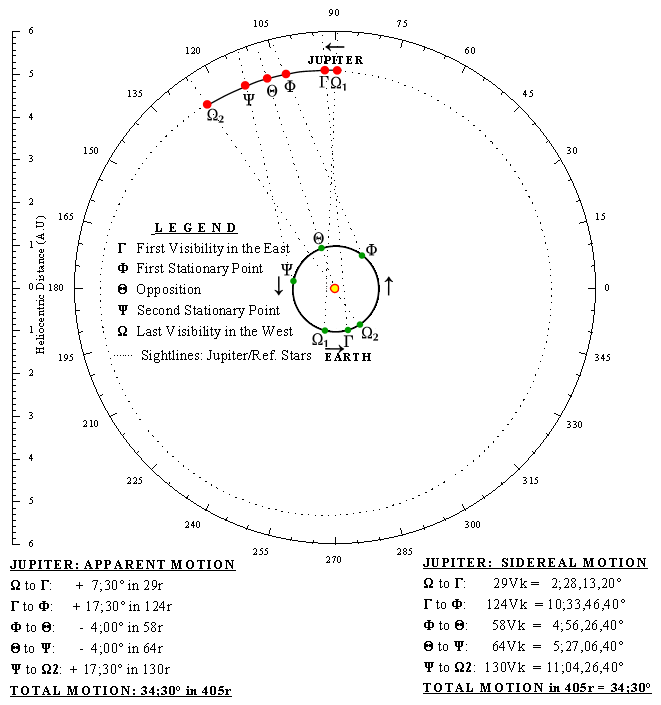
3.
The relative sidereal/synodic motions of Earth and Jupiter for the
medium synodic arc.
SYNODIC MOTION
Referring to Figure 3, the elliptical orbits of Earth and
Jupiter are displayed on a 360 degree sidereal reference frame with
Jupiter
initially at the 90 degrees at the point that corresponds to the
synodic velocity of 34;30 degrees and Earth initially at 257 degrees.
Fixed sidereal
velocities of one degree per tithi for Earth and a velocity Vk =
34;30/405r = 0;5,6,40 degrees per tithi for Jupiter produce the
positions for the
Babylonian "characteristic" phenomena over one complete synodic cycle
for Jupiter and the specific synodic arc in question. The example may
perhaps shed some light on the puzzling statement found in ACT 814
(Sect. 2,
L9): "for the first station it is high, for the second station it is
low" in so much as the synodic velocity that started at 34;30 degrees
falls to
almost 34 degrees by the time the second stationary point is reached.
Needless to say, the above also shows that such phenomena as stationary
points and retrograde motion are clearly apparent and it is undoubtedly
direct
orbital motion that is under consideration throughout. Thus for mean
values, because of the fundamental period relationship for Jupiter, the
Mean synodic arc (u) = (Zx360)/II and Mean synodic time =
(Nx12;22,8)/II,
unit time per degree is therefore obtained from: (Nx12;22,8)/(Zx360)
= N/Z(1;1,50,40).r/o
In the case of Jupiter, this parameter (unit time per degree) is:
(427/36)(1;1,50,40) r/o
= 12;13,32,46,40r/o
or 12.0344361337...days
per degree, which is unquestionably the
sidereal motion of Earth for
each degree of Jupiter's sidereal
motion. Moreover, Babylonian fundamental period relations for Mars and
Saturn also produce
corresponding times for the motion of Earth. For example, from the full
Babylonian period relationship for Saturn of 265 years, 256 mean
synodic arcs and 9 periods of revolution, the
mean synodic arc of 9x360/256 =12;39,22,30 degrees Saturn takes
12;48,13,26,15 months and thus the planet moves 0;2,0,30,11,42,...
degrees per day. Thus dividing the latter into one sidereal revolution
of 360 degrees results in 10,754;53,47,35,41,... (10,754. 89655...)
days to complete one mean sidereal period. The further division of this
total by the number of
days in the standard 12;22,8-month Babylonian year next produces
29;26,40 (29.444* years), the attested Babylonian mean sidereal period
for the planet in question. On the other hand, the Babylonian
fundamental period
relationships for the two inferior planets (Mercury and Venus) provide
only the number of years (N) and the number of synodic occurrences
(II). This would
seem to be one of the two the major factors which have hitherto
mitigated against a fictive understanding of the Babylonian approach to
planetary motion;
the other is the apparent motion of the Sun in both planetary and
luni-solar contexts. Yet these two factors are necessarily related and
the motion of the sun in Babylonian astronomy need be no more
indicative of Babylonian theoretical basis than is our own retention of
solar motion for computational convenience (i.e., the slow, mean, and
fast
sun applied to the equation of time, etc). Thus, as Zombeck (1993)
explains in a modern astronomical treatise on the motion of the moon: 26
"It would be natural but impractical to describe the motion of the moon
in heliocentric coordinates. In the method used here to determine the
position of the moon we shall consider that
both the Sun and the Moon are in orbit about Earth. The position of the
Sun was calculated in Section 2.1 under this assumption, and we shall
use these calculations to correct the mean
orbital elements of the moon for solar perturbations."(emphases
supplied)
With respect to the planets, from a distinctly fictive heliocentric
viewpoint, the sidereal motion of an outer superior planet provides
the synodic arc, while the sidereal motion of the inner planet (Earth)
supplies the unit of time. In the case of the inferior planets,
from the same heliocentric viewpoint, Earth is now the outer planet,
therefore its motion provides both the synodic arc and
the synodic time, which renders the numbers of sidereal periods for
Mercury and Venus completely superfluous. In other words, the number of
years (N) in the period relationships for the latter pair is also the
number of revolutions (Z) of Earth. Even though the Babylonian
treatment of
planetary phenomena pertains to synodic rather sidereal velocity, on
further examination the approach is nonetheless found to represent
direct, forward sidereal motion per unit time. Finally, with
Earth in motion, the relations: 12;22, 8 / 360 = 1;1,50,40 r/oand N x 12;22, 8 / II apply
consistently to the known Babylonian fundamental period relations, as
shown with
largely decimal values for simplicity in the following table:
|
PLANET
|
N
|
Z
|
II
|
T =
N/Z
|
Synodic
Arc
|
Synodic
T1
|
Synodic
T2
|
Degrees/day
|
|
SATURN
|
265 |
9 |
256 |
29.444444 |
12.65625 |
12.80373 |
378.10183 |
0;02,00,11,30,42
|
JUPITER
|
427 |
36 |
391 |
11.861111 |
33.14578 |
13.50771 |
398.89077 |
0;04,59,08,29,37
|
MARS
|
284 |
151 |
133 |
1.8807947 |
408.72180 |
26.41176 |
779.95505 |
0;31,26,31,01,24
|
VENUS
|
1151 |
1871 |
720 |
0.6151791 |
575.50000 |
19.77304 |
583.90971 |
0;59,08,09,04,37
|
Mercury
1
|
46 |
190 |
144 |
0.2421053 |
115.00000 |
3.95117 |
116.68048 |
0;59,08,09,04,37
|
Mercury
2
|
46 |
191 |
145 |
0.2408377 |
114.20690 |
3.92392 |
115.87579 |
0;59,08,09,04,37
|
Mercury
a
|
848 |
3521 |
2673 |
0.2408407 |
114.20875 |
3.92399 |
115.87767 |
0;59,08,09,04,37
|
Mercury
b
|
388 |
1611 |
1223 |
0.2408442 |
114.21096 |
3.92406 |
115.87991 |
0;59,08,09,04,37
|
Mercury
b2
|
480 |
1993 |
1513 |
0.2408430 |
114.21018 |
3.92404 |
115.87912 |
0;59,08,09,04,37
|
Mercury
d
|
217 |
901 |
684 |
0.2408435 |
114.21053 |
3.92405 |
115.87947 |
0;59,08,09,04,37
|
Table 2. Babylonian Period
Relations
NOTES
N is the number of years in the
final integer period relation.
Z is the corresponding number of
mean sidereal periods, i.e., number of
complete sidereal revolutions.
II is the corresponding number of
mean synodic arcs and corresponding
mean synodic periods.
T = N/Z = The mean sidereal period
in years, i.e., one sidereal
revolution.
Synodic Arc = The mean
synodic arc in degrees (decimal notation).
Synodic T1 is the mean synodic time
expressed in mean synodic months
(decimal notation).
The mean synodic time is
expressed in days (decimal notation).
The mean synodic month
provides the standard unit of time, i.e., the constant of 29;31,50,8,20
days
The mean synodic arc for
Mars is given in full; the applied value is the excess over 1 x
360 degrees.
The corresponding motion of Earth (with respect to that of Mars) is the
excess over 2 x 360 degrees.
For a more accurate set of
hypothetical period relations for VENUS see
Appendix B.
The mean sidereal periods
for the two inferior planets (in parenthesis) are implicit.
The identical degrees/day
for the inferior planets results from the mean motion of Earth.
METHODOLOGY
The periods and velocities in Table 2 above are derived from the
integer elements of Babylonian fundamental relationships, i.e., the
integer
parameters N, Z and II. The resulting periods and
velocities are impressive, even though the mean synodic arcs for both
Jupiter and Mars were rounded by the
Babylonians from 33;8,44,48,29,. to 33;8,45 degrees for the former, and
further reduced for the latter to the excess over one revolution, i.e.,
408;43,18,29,46,27,.. minus 360 to obtain the mean arc of 48;43,18,30
degrees. This modification notwithstanding, the complete synodic arc
and resulting mean synodic
period for Mars nevertheless still provide the correct motion for Earth
expressed in degrees per day. The standard unit of time in all cases
was the Babylonian
"year" of 12;22,8 mean synodic months, which may also be treated as the
time required for Earth to complete one sidereal revolution of 360
degrees. This corresponds to the daily
motion of Earth of 0;59,8,9,04,36,59,.degrees associated with the
period relationships for the two inferior planets as explained
above. The sidereal periods
for the latter pair are implicit in the relationships, and although not
required they may still be obtained from the standard relation ( Z = N + II ), i.e.,
Z =
Number of Years N + Number of Synodic Periods.
The period relationships
for Mercury concern either the general
statement (2) "145 phenomena of the same kind in 46 years," or
specific observational
phenomena given in ACT (pp.283-288), i.e., from the following:
( a )
"2673 appearances as a morning star" ( First visibility in
the east )
( b )
"1223 disappearances as a morning star" ( Last visibility
in the east )
( b2) "1513
appearances as an evening star" ( First visibility in the
west )
( d )
"684 disappearances as an evening star" ( Last visibility in the west )
Fig. 4. The
six observational points for
Venus and Mercury
The
less accurate Mercury relationship from ACT 816 (i.e., No.
1) appears to represent a pedagogical simplification associated with
the
determination of a "System B" type variable velocity function. In this
case the
extremal velocities would be m
= 97;00 degrees and M =
133;00 degrees.
With the same
value for the difference d,
the extremal velocities for the 46-year/145
arc relationship would be in turn: 96;04,54,49,4 degrees and
132;19,54,49,40 degrees respectively.
It may be remarked that none of the final data for Mercury and Venus
necessarily reflect observational periods per se, any more than do those of
the superior planets. In fact it seem possible that the
entire corpus of planetary relations based on the T1:T2 pairings could
have been generated over perhaps a century or less, though this need
not be taken as indicative of the comparative newness of Babylonian
astronomy on one
hand or the limits of their inquiries on the other. They are simply
fragments of what have come down to us. How extensive was Babylonian
astronomy?
How far back in time did it extend and what else remains? Short of
additional material these questions may remain unanswered, although
there are undoubtedly intriguing aspects that still defy explanation,
especially a strangely ignored mathematical problem concerning a
trapezoid that occurs in
Jupiter procedure texts ACT 813 and ACT 817 (see below), along with
still unknown
corrections and parameters in the luni-solar texts.
SUMMARY [ 1997 ]
Whether one accepts what has been discussed here or not, it should at
least be recognized that complex issues arising from precession, the
various types of months, and the definition of the "year" merely
represent the luni-solar component of Babylonian astronomy while
further questions arise from the limited number and uneven distribution
of the planetary texts published in ACT and elsewhere. In fact,
there would appear to be sufficient gaps and uncorrelated parameters to
suggest that Babylonian astronomy was almost certainly more developed
than is usually assumed. Included in this latter group are unexplained
parameters and operations in the planetary texts and unknown
corrections for both the
solar velocity 27 and the
zodiac 28 in the lunar
material.
One might also consider the implications of the extensive range of the
Babylonian period relations, synodic phenomena in association with
varying, direct, and retrograde velocity,
closed orbits, lines of apsides, and not least of all, the
aforementioned trapezoid in two astronomical procedure texts for
Jupiter.29 (For
further details see Otto Neugebauer's minimal treatment of the trapezoid in
Astronomical Cuneiform Texts
(single-page PDF, 34 kb).
Given
the undoubted awareness of accurate sidereal
periods for the superior planets, implicit sidereal periods for the
inferior planets,
accurate sidereal, synodic, draconic, and anomalistic months, and
varying velocity functions for the planets, sun, and moon - all readily
understood in terms of a cohesive framework - it seems reasonable to
conclude that the Babylonians almost certainly possessed a
well-developed, fictive
heliocentric planetary model by 250 BCE at the very latest, and quite
possibly much earlier.
REFERENCES
1.
Neugebauer, O. Astronomical
Cuneiform Texts (Lund Humphreys, 3 Vols, London, 1955).
2. Neugebauer, O. A History of
Ancient Mathematical Astronomy (Springer-Verlag, Berlin, 1975).
3. Van der Waerden, B. Science
Awakening II The Birth of astronomy, with contributions by Peter
Huber (Oxford University Press, New York, 1975).
4. Astronomical Cuneiform Texts,
Ed. O. Neugebauer (Lund Humphreys, London, 1955)404.
5. Harris, J. Letter to the Editor of
ISIS, Vol. 68, No.245, December 1977:626-617.
6. Astronomical Cuneiform Texts,
Ed. O. Neugebauer (Lund Humphreys, London, 1955) 414.
7. Manitius, K. Ptolemaus Handbuch
Der Astronomie (B.G. Teubner, Leipzig, 1963)100.
8. Duncan, A. On the Revolutions of
the Heavenly Spheres (Barnes and Noble, New York, 1976) 235-236.
9. Newton, R. The Crime of Claudius
Ptolemy (Johns Hopkins University Press, Baltimore and London,
1977).
10. Newton, R. The Origins of
Ptolemy's Astronomical Parameters (Technical Report No. 4,
Center for Archaeoastronomy, College Park, Maryland, 1982).
11. Newton, R. The Origins of
Ptolemy's Astronomical Tables ( Technical Report No. 5, Center
for Archaeoastronomy, College Park, Maryland, 1985).
12. Goldstein, B. Al-Bitruji: On the
Principles of Astronomy (Yale University Press, New Haven
London, 1971)
13. ACT 210, Section 3, Astronomical
Cuneiform Texts (Lund Humphreys, London, 1955) 271-273.
14. Op. cit., p. 272.
15. Neugebauer, O. A History of
Ancient Mathematical Astronomy (Springer-Verlag, Berlin, 1975)
503.
16. Op. cit., p.518.
17. ACT 210, Section 3, Astronomical
Cuneiform Texts (Lund Humphreys, London, 1955) 272.
18. Hartner, W. "The Young Avestan Calendar and the Antecedents of
Precession," JHA, Vol X
(1979) 1-22.
19. Neugebauer, O. Astronomical
Cuneiform Texts (Lund Humphreys, London, 1955) 70.
20. Aaboe, A. "A Seleucid Table of Daily Solar (?) Positions" Journal of Cuneiform Studies, Vol.
18 (1964) 34.
21. Sachs, A. "The Goal-Year Texts," Journal
of Cuneiform Studies Vol. 2 (1948).
22. Neugebauer, O, and A. Sachs. "Some Atypical Astronomical Cuneiform
Texts I," Journal of Cuneiform
Studies, Vol. 21 (1967) 183-218.
23. ACT 813, Section 1, Astronomical
Cuneiform Texts (Lund Humphreys, London, 1955):403-404.
24. ACT 813 , Section 20,
Astronomical Cuneiform Texts (Lund Humphreys, London,
1955):414-415
25. ACT 812, Section 2, Astronomical
Cuneiform Texts (Lund Humphreys, London, 1955):393-394.
26. Zombeck, M. Astronomical Formulas, Section 2.2, MATHCAD Electronic Books,
(MathSoft Inc., 1993.).
27. ACT 200, Sections 7 and 9, Astronomical
cuneiform Texts (Lund Humphreys, London, 1955) 193-195, 198.
28. ACT 202, Section 2, Astronomical Cuneiform Texts (Lund Humphreys,
London, 1955) 242-244.
29. ACT 813, Section 5, Lines 1-4, ACT 817, Section 4, Lines 1-12, Astronomical Cuneiform Texts, 405;
430-431.
30. Hoyrup, Jens. Lengths, Widths,
Surfaces: A Portrait of Old Babylonian algebra and its Kin
(Springer-Verlag, New York,2002).
31. Robson, Eleanor. Mathematics in
Ancient Iraq: A Social History (Princeton University Press, New
Jersey, 2002).
33. Friberg,Jöran. Unexpected
Links between Egyptian and Babylonian Mathematics (World
Scientific Publishing, Singapore, 2005).
34. __________ A Remarkable
Collection of Babylonian Mathematical texts (Springer, New York.
2006).
35. __________
Amazing Traces of a Babylonian Origin
in Greek Mathematics (World Scientific Publishing, Singapore,
2007).
36. Davis,
Linda. Technical Mathematics with
Calculus (Merrill Hill, Columbus, 1990).
37.
Swerdlow, Noel M. The Babylonian
Theory of the Planets. (Princeton University Press, Princeton,
1996).
SUPPLEMENTARY INFORMATION I
Babylonian
Mathematics and Sexagesimal Notion: Comments and a few examples.
Copyright
© 1997.
John N. Harris, M.A.(CMNS).
Last updated on May 1, 2012.
APPENDIX
A
HYPOTHETICAL
BABYLONIAN PARAMETERS FOR URANUS
THE NAKED-EYE
VISIBILITY OF
URANUS
Preliminary Remarks:
1. URANUS, discovered
fortuitously by
William
Herschel with the aid of a
telescope
in 1781
is unquestionably visible
to the naked eye1,
2 ,3
2. As Wagner [1991] has pointed out, it is in fact surprising
that URANUS
was not detected in antiquity.4
3. Babylonian
astronomers
- long skilled in observing planetary risings and settings etc., would
have been prime candidates for the incidental discovery
of a faint (but visible) outer planet moving in essentially the same
orbital plane as
Mars, Jupiter and Saturn.
4. If detected, URANUS could well have been subjected to the same
Babylonian
procedures adopted for the three attested superior planets, leading to
the eventual determination of the corresponding
planetary parameters discussed below.
5. Hypothetical Babylonian parameters for URANUS (Systems A and B) are
given
below for comparison with values that may be encountered in the future.
I. MEAN VALUES
As discussed in detail above, the final Babylonian fundamental
period
relationships for the three known
superior planets appear to have depended on two initial
integer
periods (T1 and T2) thaty are close to the mean sidereal periods (or
multiples
thereof) for which small, convenient corrections for longitude of
opposite
sign were determined; leading in turn to the final integer
period when the corrections completely
cancel out.
for example, (using Neugebauer's terminology from ACT, pp.282-283), the
relationship for
Jupiter was
expressed
as: N Years = II synodic
"appearances" and Z sidereal "rotations" of
360
degrees, but in so much as the mean synodic arcs for both Jupiter and
Mars were rounded at the
third
sexagesimal place, and that of Saturn was exact. (265 Years = 256
synodic appearances and 9 sidereal revolutions; mean synodic arc u = 9 x 360 / 256 = 12;39,22,30
degrees) is would appear that both accurate and rounded values were
applied. Either way, however,what will be required in the case of
Uranus are initally the two periods T1
and T2 (with attendant
corrections in longitude) that will provide the final integer
relationship Tn. Thus, based
on a period of
revolution of Uranus of approximately 84 years, for example, the
initial
pairs of
periods with the requisite corrections in longitude leading to the
final
period relation
can be suggested:
T1 = 81 Years, = 80
synodic arcs and 1 sidereal
revolution
of 360 degrees -10;00 degrees
T2 = 85 Years, = 84 synodic
arcs and 1 sidereal revolution
of 360 degrees + 7;30 degrees
leading to a
final integer period relationship
for Uranus of Fn
= 583
years as
follows:
T1
= 81
Years, 80 synodic
arcs, 1 revolution of
360
degrees - 10;00 Degrees
T2
= 85 Years, 84
synodic arcs, 1 revolution of 360 degrees + 7;30 Degrees
T3 = 166 Years, 164 synodic arcs,
2
revolutions of 360 degrees - 2;30
degrees (T1 + T2)
T4 = 251 Years, 248 synodic arcs,
3
revolutions of 360 degrees + 5;00
degrees (T2 + T3)
T5 = 417 Years, 412 synodic arcs,
5
revolutions of 360 degrees + 2.30
degrees (T3 + T4)
FN
= 583 Years, 576 synodic arcs,
7 revolutions of 360
degrees
and 0;00 degrees correction (T3 + T5)
thus, according
to standard methodology, the hypothetical mean values
for
Uranus based on a final period Fn
of 583
years would be in turn:
Mean Sidereal Period
= N/Z = 583/7 = 83.28571428 Years
Mean Synodic Period = N/II =
583/576 = 1.01215277
Years
Mean Synodic Period (months)
= 583 x
12;22,8 Months / 576 = 12;31,9,8,20
Mean
Synodic Months
Mean Synodic Arc (u) = N x
360 / II = 7 x 360 / 576 = 4;22,30
degrees
[ Mean Heliocentric Distance: 19.0713 A.U.]
ADDITIONAL
OPTIONS
Other
possibilities include final period relations of:
a.
249
years (3 sidereal revolutions)
b. 420 years (5
sidereal
revolutions)
c.. 565 years (7
sidereal
revolutions)
d. 586 years (7
sidereal
revolutions)
e. 587 years (7
sidereal
revolutions)
f. 589 years
(7
sidereal
revolutions)
with intermediate periods, corrections, and mean parameters (u is the value of the mean synodic
arc in degrees) as follows:
f. N = 589 Years, Z = 7,
II = 582
Mean Sidereal Period T = 84.14285... Years
Mean synodic arc u
= 4;19,47,37,43,..(4;19,45 rounded?)
Mean
Heliocentric Distance: 19.2019 A.U.
T1 = 82 Years (360 -
9;10)
T2 = 85 Years (360+ 3;40)
e. N = 587 Years, Z = 7,
II =
580
Mean Sidereal Period T = 83.85714... Years
Mean
synodic arc u
=
4;20,41,22,45,..(4;20,40 rounded?)
Mean Heliocentric
Distance: 19.1584 A.U.
T1 = 81 Years (360 - 12;15)
T2 = 85 Years (360+ 4;54)
d. N = 586 Years, Z = 7,
II =
579
Mean Sidereal Period T = 83.71428... Years
Mean synodic
arc u =
4;21,08,23,37,..(4;21 rounded?)
Mean
Heliocentric Distance: 19.1367 A.U.
T1 = 83 Years (360 -
3;00)
T2 = 84 Years (360+ 1;12)
c. N =
565 Years, Z = 7,
II =
559
Mean Sidereal Period T = 80.71428... Years
Mean
synodic arc u
=
4;30,58,03,52,..(4;31 rounded?)
Mean Heliocentric
Distance: 18.6767 A.U.
T1 = 80 Years (360 - 3;10)
T2 = 81 Years (360+ 1;16)
b. N = 420 Years, Z = 5,
II =
415
Mean Sidereal Period T = 84 Years
Mean synodic
arc u =
4;20,14,27,28,..(4;20,15 rounded?)
Mean
Heliocentric Distance: 19.1802 A.U.
T1 = 81 Years (360 -
12;45)
T2 = 86 Years (360 + 8;30)
a. N = 249 Years, Z = 3,
II =
246
Mean Sidereal Period T = 83 Years
Mean synodic
arc u =
4;23,24,52,40,..(4;23,20 rounded?)
Mean
Heliocentric Distance: 19.0277 A.U.
T1 = 81 Years (360 -
8;40)
T2 = 84 Years (360 +4;20)
NOTES:
The selection of the above periods was partly influenced by 589
and 83-year Jupiter period
relations in Babylonian "Goal-Year" texts (
the latter period is also the sum of Jupiter T1 = 12 years and Jupiter
T2 = 71 years).
The corrections for the 583-year
period are based on
information
in a lunar text (ACT 210, Section 2) found in a line preceding the
possible
mention of the 265-year fundamental period for Saturn. The fragmentary
condition of the section and the absence of a second correction make
this insecure data doubtful. Nevertheless, the resulting 583-year period provides a
convenient mean synodic arc of 4;22,30
degrees, which is
generally
in keeping with attested Babylonian mean values for the other visible
superior planets (Mars,
Jupiter
and Saturn).
Less likely data based on a 565-year
final period (7
sidereal
revolutions; mean synodic arc:
4;30,58,3,52,..) owes its origins to the
unexplained occurrence of the number "4
31" found in an early
Babylonian
text concerned with "omens" associated with a cryptic reference to a
moving
"star" in the constellation of Pisces, i.e., "If the Fish Star
approaches
the Acre Star..." with the latter considered to be in the adjacent
constellation
Pegasus.
The mean heliocentric distances range from 19.202
A.U. through 18.677 A.U.
The average value is 19.064985
A.U. Both this value and that of the 83-year period round
conveniently to 19.
II. HYPOTHETICAL SYSTEM A PARAMETERS FOR URANUS
Based on modern aphelion and perihelion distances,
Babylonian System
A synodic arcs for Uranus might perhaps center around 4;20
degrees for
the mean
value with 4;2 degrees and 4;40
degrees for "Slow" and "Fast" arcs distributed over 200 and 160 degrees
respectively, i.e., as applied in the case of Saturn. Or alternatively,
around 4;00 and 5;00 degrees with a corresponding mean synodic arc (u)
closer
to 4;30 degrees, etc.
Finally, for a mean synodic arc of precisley 4;31 degrees the
corresponding times for various approximations would
be:
1.
12;31,26,39,41,20 months (k =
11,12,19,50,40)
2. 12;31,26,40 months for k =
11;12,20 r
3. 12;31,26 months for k = 11;12
r.
III.
HYPOTHETICAL SYSTEM B VELOCITIES FOR URANUS
BASIS:
THE
583-YEAR INTEGER PERIOD RELATIONSHIP FOR URANUS:
N = 583
YEARS, II = 576 SYNODIC ARCS, Z = 7 SIDEREAL REVOLUTIONS
P = Number of mean
synodic arcs per sidereal revolution =
360/u
T = Sidereal Period = P + 1
d =
Increase/decrease in velocity (degrees) and time (tithi) per
synodic
arc = 0;1,10
Amplitude
of Synodic Arcs = 1/2Pd
= 0;48 (1/4Pd = 0;24)
m = Minimum Synodic Arc: ( u
- 1/4Pd) = 3;58,30 degrees
u = Mean
Synodic Arc: [(7 x 360 )/576] = 4;22,30
degrees
M = Maximum Synodic Arc (u
+1/4Pd) = 4;46,30 degrees
The 583-year period is used here for simplicity. The attested
determination
of the mean synodic arc (u) from the division of the total sidereal
motion
by the number of synodic arcs in the final relationship would be
followed
by the derivation of the parameters of a "linear zigzag" function given
above and below. The difference, d = 0;1,10 is on the high side, but
closer
to the approximate 9 : 1 ratios of the Mars : Jupiter and the Jupiter :
Saturn differences. Values for this parameter might range from 0;40 to
perhaps 0;1,20. (note: The derivation of the extremal velocities
follows the
procedure
suggested by the remnants of Section 1 of Jupiter procedure text ACT
812
)
IV.
HYPOTHETICAL SYSTEM B TIMES FOR URANUS
(a) SYNODIC FACTORS IN
TITHIS (Synodic Arc + k3 =
Synodic
Arc + 11;12,4,10,r Abbreviated value:
+11;12 r )
(m) = 15;10,51,40
r
Minimum
Synodic Arc (abbreviated value: 15;10,30
)
(u ) = 15;34,34,10 r Mean
Synodic
Arc
(abbreviated value: 15;34,30 )
(M) = 15;58,16,40 r Maximum
Synodic
Arc (abbreviated value: 15;58,30
)
(b) SYNODIC PERIODS
(MONTHS)
[ IV
(a) Values/30 + 12 Mean Synodic
months]
(m) = 12;30,21,43,20
mean
synodic months
(u ) = 12;31,9,8,20 mean
synodic months (369.699569 days)
(M) = 12;31,56,33,20 mean
synodic months
The synodic times in tithis and mean synodic months were derived
according
to the method given in Section 2 of Jupiter text ACT 812 (Neugebauer,
Astronomical
Cuneiform Texts, Lund Humphreys, London 1955:393). The mean synodic
time for Uranus is also obtainable from the final integer relationship
and the methodology indicated in Section 1 of the same text, i.e., the
mean synodic time is accordingly:
583
x
12;22,8 / 576 = 12;31,9,8,20
mean synodic months (of
29;31,50,8,20
days).
V.
THE SELEUCID ERA
The Seleucid Era - a Babylonian astronomical era of unknown
significance
- begins with Month 0, Year 0 in April 310 BC (311 BCE).
As it so happened, Uranus was occluded three times by Jupiter
around this
time, i.e., on September 23, 312 BCE, January
2, 311 BCE ( Uranus at opposition and nearly at
its
brightest, M = +5.4 ) and April 29, 311
BCE,
i.e., April 310 B.C. Those with astronomical software can
observe
from the location of Babylon (Iraq: 44 25E, 32 33N) the positions of
both
planets, the perceptible parallax exhibited by Uranus with respect to
Jupiter
between the dates given and the planet's later motion (at its
brightest)
along the ecliptic through the constellation of Leo.
SUMMARY
Firstly,
because of the relatively low visual magnitude of Uranus it is
possible
that even if sighted the orbit could not be completely determined.
Secondly,
although
no
unambiguous references to an additional planet are apparent in the
historical
record there nevertheless remain enigmatic statements and parameters
of
unknown significance in both earlier Babylonian material and the
astronomical
cuneiform texts of the Seleucid Era.
Moreover, complex issues arising from "precession", the various types
of months,
and
the definition of the "year" represent the luni-solar component
of Babylonian astronomy which is itself in need of additional research
from a dynamic viewpoint.
Others
issues arise from the limited number
and
uneven distribution of the extant planetary texts. In fact,
sufficient
gaps and uncorrelated parameters remain to suggest that Babylonian
astronomy
was quite likely more developed than is normally assumed.
Until
the
matters outlined above and at the end of the parent paper are
addressed more adequately, it would
surely
be premature to dismiss the capabilities of Babylonian astronomers, or
their possible naked-eye detection of Uranus, conventional wisdom and
the status quo notwithstanding.
APPENDIX
B
HYPOTHETICAL PERIOD
RELATIONS FOR VENUS AND MERCURY
B1: VENUS
PRELIMINARY REMARKS
In general, it may be assumed that shorter Babylonian period
relationships will
provide less accurate mean values than those obtained from F, the Final (and exact) integer
period relationship determined from the initial T1 and T2 periods, e.g.,
F = 284 Years, 133 Mean Synodic Arcs, 151 Orbital Revolutions [MARS]
F = 427 Years, 391 Mean Synodic Arcs, 36 Orbital Revolutions [JUPITER]
F = 265 Years, 256 Mean Synodic Arcs, 9 Orbital Revolutions
[SATURN]
F = 583 Years, 576 Mean Synodic Arcs, 7 Orbital Revolutions
[URANUS(?)]
However,
for
Mercury and Venus no corresponding T1 and T2
periods are readily apparent; furthermore, in the case of Venus the
1151-year relationship yields a relatively poor value for the
mean synodic period. Nor,
for that matter, does the corresponding mean synodic
arc inspire confidence, being simply one half of the period itself
(i.e., 1151*360/720 = 1151/2 = 575;30 degrees). The latter may well be
a working value, and a convenient one at that, but with a length of
1151 years for the final
integer period one might reasonably have expected more accurate
results.
Recalling, however, the key period relations
for
Jupiter
provided in Section
1 of
ACT
813 (see
above) 23
"Compute
for the whole zodiac (or: for each sign) according
to the day and the velocity.
In 12 years you add 4;10, in 1,11 years
you
subtract 5, in 7,7 years the longitude (returns) to its original
longitude."
(In 12 years you add 4;10 degrees, in 71 years
you
subtract 5 degrees, in 427 years the longitude returns to its original
longitude)
and the
expansion that produced the attested period relation
for Jupiter of:
427 years, 391 mean synodic arcs and 36
sidereal
revolutions
Table.1 Babylonian
Period Relations and the 427-year Long Period for Jupiter
one could do
little more than hope that additional periods for Venus and Mercury
might
eventually come to light from newly recovered cuneiform tablets etc.,
and failing this, from other historical sources.
THE
243-YEAR PERIOD I
In the latter category, for example, there is the interval of 243 years
mentioned in the following cryptic footnote by George Burges (1876:171):
. . . . the
ratio of 243 to 256 is to that of 35 to
44; especially if we bear in mind what is stated by
Plutarch,
De Anim., Procreat. ii, p.
1028, B., respecting Lucifer (Venus) being represented by 243, and the
Sun by 729.
(George Burges, The Works of Plato,
George Bell and Sons, London, 1876:171) 10
THE 8-YEAR PERIOD
Although it may
seem an unnecessary elaboration " the ratio of 243 to 256 is to
that of 35 to 44 " may also be
restated as: " the ratio of 243 to 256 is to that of 35 to 28 ", but apart from
the
well-known Venus/Fibonacci relationship of 5
synodic periods, 8 years and 13 orbital revolutions, little in the way
of additional understanding
follows. But this is numerology
in any
case, is it not? Possibly, but it is more likely methodology,
and highly condensed methodology at that. But in any event, the parent
work itself is
found in "The Treatise of Timaeus the Locrian" in Burge's
The Works of Plato (1876)
whereas initial references to the number "243" occur in a distinctly
"Pythagorean" context, i.e., in a footnote to Burge's own
SUPPLEMENTARY NOTE to (yet another extension) "The Notes of
Batteaux." However, since we are not so much concerned here with
Pythagorean
tenets as the determination of fundamental period relations for Venus
the latter subject is perhaps best left for a more specialized
treatment at another time.
Nevertheless, it might still be
unwise to "criticize
without light."
THE
251-YEAR PERIOD;
ADDITIONAL COMPLEXITIES
So
far so good, though merely the 8-year Venus cycle with its 5
corresponding synodic periods and 13 corresponding orbital
revolutions, and an obscure historical reference to an interval of 243
years. What next? As far as my own efforts were concerned, nothing at
all. It
was in fact the Internet
that supplied the answer, providing both
intermediate periods T1, T2 as well as F,
the final"long" integer relationship in one neat, detailed package. The
source in question, however, dealt with matters far more difficult than
the present historical asterisk, namely the complexities that arise
from the analysis of the
transits of Venus carried out by Karl-Heinz and Uwe Homan. For present
purposes, however, the following periods discussed
in detail by the latter ( VENUS
TRANSITS AND PRECESSION, May 31, 2004):
A preliminary
analysis of the Venus Transit Data has shown that the Earth must go
around the Sun 360 degrees in a tropical year, contrary to current
lunisolar precession theory. The fact remains and the evidence suggests
that the observed transit cycles reflect a more accurate correlation
between the periods of 251 tropical years and 408 orbits of Venus
around the Sun, than 243 and 395 respectively.
This paper
examines what appears to be a pattern of resonance between Venus
transit cycles, the mean synodic period and the time interval of the
360-degree tropical year based on Earth's non-precessing axis of
rotation relative to the position of the Sun. .... A complete 360-degree
cycle occurs after 157 mean synodic periods, or exactly 251 tropical
years and 408 orbits of Venus.
( Uwe Homan, The Sirius
Research Group, May 31, 2004; emphases suppplied)
plus the 5,
152 and 157
Venus
synodic periods and corresponding 13,
395 and 408 orbital periods
applied in an earlier paper (TRANSITS
OF VENUS VS NASA'S ASTRONOMICAL DATA,
April 21, 2004) provide all that is
necessary. In these modern contexts the latter sets are discussed in
detail with respect to both the tropical year and the sidereal year
with far-reaching implications; in
our
present historical context, however, all six
periods may simply be used directly after the manner adopted
for Jupiter, i.e., hypothetically:
"In 8 years you add 1;26,
In 243 years you subtract 1;26.
In 251 years the longitude (returns) to its original longitude."

Table 2. Hypothetical Babylonian
Period Relations for Venus
Final Period F = 251 years, 157 mean synodic arcs and 408
orbital
revolutions.
In Table 2 the longitude corrections of
1;26 degrees are conveniently truncated from the more accurate
value of 1;26,3,20,47,48,..(1.434262948.. degrees); the positive
correction the excess over
360 degrees after 8 years, the negative correction the
amount less than 360 degrees
after 243 years.These corrections necessarily involve
the annual orbital motions of Earth
and Venus, the latter value being 585;10, 45,25,5,58,33,(
585.179282868. degrees from the 251-year relationship,
i.e., from 408 x 360 / 251).
Finally, though not to be confused with
the modern complexities that attend this matter, the mean synodic period for
Venus (based on the Babylonian year of
12;22,8 mean synodic months) can be otained from the final
period as before, i.e.,
251
x 12;22,8 / 157 =
19;46,28,4,35,9,
(19.774465676...) mean synodic months, or simpler still: 19;46,30 months.
B2:
MERCURY
13-YEAR AND 33-YEAR PERIODS
Although a similar situation exists for Mercury, i.e., no attested T1 and T2 periods or related
Final Period (F), the available
material for this planet is
nevertheless more extensive. However, remaining with the better known
46-year period that has come down to us in various planetary theories
(e.g., those of Ptolemy, Al-Bitruji, and Copernicus) the methodology
applied in the case of Venus -- apart from the reversed polarity of the
paired corrections -- remains virtually unchanged, i.e.,
"In 13 years you
subtract 7;50, In 33 years you add
7;50.
In 46 years the longitude (returns) to its original longitude."

Table 3. Hypothetical Babylonian
Period Relations for Mercury
Final Period F = 46 years, 145 mean synodic arcs ( 191 orbital
revolutions )
Here
again the longitude corrections (7;50 degrees in this instance; to two
sexagesimal places perhaps: 7;49,30 ) are simplified variants of more accurate values
obtainable from the 46-year final relationship ( i.e.,
7;49,33,54,46,57, ..., 7.826086956 .. degrees) and the
combined annual orbital motions of both Earth (360 degrees) and Mercury
(1494;46,57,23,28,41,44, ... degrees, etc.). In this case, however, the
negative correction is the amount less
than 360 degrees for T1 (13
years) and the positive correction the excess for T2 (33 years). Based on the
final 46-year integer relation the mean synodic period will accordingly
be:
46
x 12;22,8 / 145 = 3;55,26,7,30 months (3;55,26,7,26,53,47..) or
more approximately, 3;55,30
months.
REFERENCES
1. Moore, Patrick.Naked
Eye Astronomy,
W.W.
Norton,
New York, 1965
2. Webb, Rev. T.W. Celestial
Objects for Common
Telescopes, Dover, New York, 1962:221.
3. Levy, D H. THE SKY - A User's Guide,
Cambridge
University
Press, Cambridge 1991:134.
4. Wagner, Jeffrey K. Introduction to the Solar System, Holt,
Rinehart and Winston, Orlando 1991.
5. ACT 813, Section 1, Astronomical Cuneiform Texts,
(Lund Humphreys, London, 1955..
6. Horowitz, W. "Two New Ziqpu-Star Texts and Stellar Circles,"Journal
of Cuneiform Studies, Vol 46, 1994.
8. Gadd, J. "Omens Expressed as Numbers," Journal of Cuneiform
Studies, Vol 21.1967.
9. Van Der Waerden, B. Science Awakening II, Oxford
University Press, New York, 1974.
10 Burges, George. The Works of Plato: A new Literal Verson,
George Bell and Sons, London, 1876.
Added July 3, 2004.
Links and text updated April 3, 2009.
mailto:
john_harris@shaw.ca
Return to spirasolaris.ca